Retail trading has changed a lot in the past twenty years, yet two names keep coming up in every broker conversation: MetaTrader 4 and MetaTrader 5. One is the platform that shaped retail forex. The other was supposed to target multi-asset brokers. In 2026, both still sit in broker stacks across the world.
According to Brokeree’s recent analysis of over 900 global brokerages, 68% offer MT5 while 40% still offer MT4. About 23% support both platforms. So, what’s different between these platforms, and which one makes sense for your business in 2026?
MT4 vs. MT5: Quick Comparison
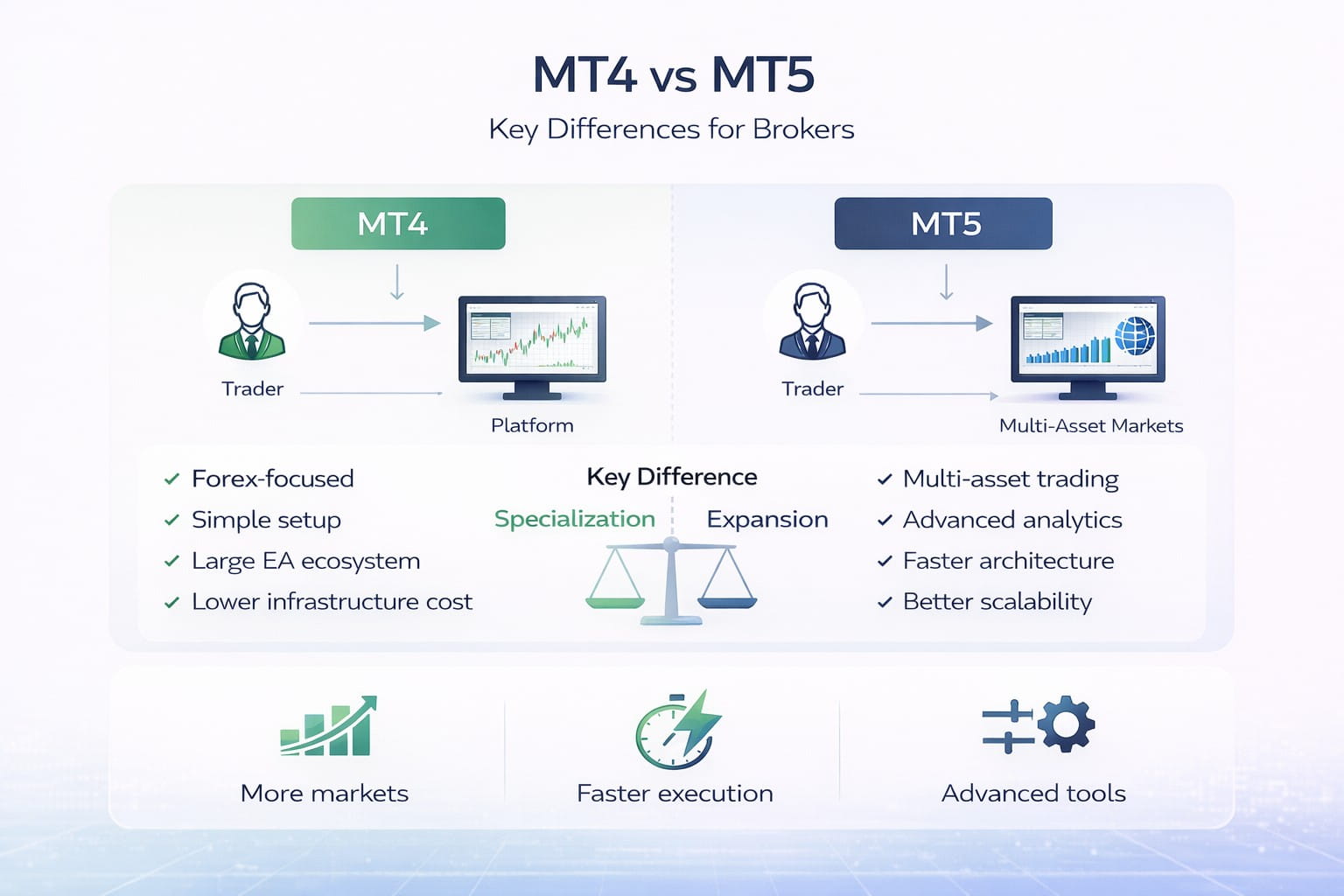
| Feature | MT4 | MT5 |
| Release Year | 2005 | 2010 |
| Market Coverage | Forex-focused | Multi-asset: forex, indices, commodities, crypto, stocks |
| Position accounting systems | Hedging only | Netting + hedging |
| Best Use Case | Forex brokers | Multi-asset brokers |
A brief history of both platforms
MT4 arrived in 2005 and grew fast because it was simple, fast, and predictable. Retail forex traders adapted to it quickly. Brokers built their infrastructure around it. Third-party developers built indicators, bots, risk tools, and bridges. MT4 became more than a platform. It became an ecosystem.
MT5 emerged in 2010 with a different ambition. MetaQuotes wanted a multi-asset platform that could support more than forex. It introduced modern architecture, improved performance, additional charting features, and broader symbol handling.
Brokers continue to run MT4 because traders still want it. They keep MT5 because it is built for growth. Dropping either one can create friction, so brokers play the long game and run both.
MT4 vs. MT5: Core Differences for 2026
The differences between MT4 and MT5 affect execution, server load, product range, automation, and risk handling.
Symbol capacity and product support
MT4 was built for forex and works well for retail CFD trading. However, brokers running large or complex multi-asset portfolios often rely on additional MT4 plugins and back office tools to manage symbol scale, reporting, and risk.
MT5 was designed to handle forex, indices, commodities, crypto, single-stock CFDs, and exchange-traded instruments with more accuracy. This matters for brokers adding new markets or expanding beyond retail forex.
Order models: hedging vs netting
MT4 allows hedging. Traders can hold buy and sell positions at the same time on a single instrument. Many retail traders prefer it because it fits their style of position management.
MT5 originally pushed netting. You have one combined position per symbol. This suits more regulated and exchange-style environments. MT5 also has hedging support, but many traders still view the two platforms through their core behaviour.
Automation and scripting
Both platforms support automated trading, but they use different languages. MT4 uses MQL4. MT5 uses MQL5, which allows more complex automation and more efficient execution.
The world has millions of MQL4 scripts that traders still depend on. Migrating them is costly for both brokers and clients. That alone keeps MT4 popular.
MT4 vs. MT5: Plugin, Bridge, and Integration Comparison
The third-party ecosystem determines a platform’s practical capabilities. MT4’s 15-year head start created a mature market for plugins, bridges, and risk management tools.
Liquidity Bridges
Connecting to liquidity providers requires bridge technology. Bridges are designed to connect MT4 and MT5 servers and aggregate liquidity from multiple providers. MT4 bridges are standardized and widely available from providers like Integral, oneZero, and PrimeXM. Every major liquidity provider supports MT4.
MT5 bridges exist, but took years to develop comparable coverage. As MT5 adoption increased, liquidity providers and technology vendors introduced MT5 gateways and bridge solutions to close the gap and support direct connectivity to pricing, execution, and risk infrastructure.
MT5 Gateway operates differently; as a component of MT5, it doesn’t require a dedicated database or server. Once the gateway is connected to the trading platform, it can interact with any elements of the MetaTrader infrastructure, enabling brokers to provide liquidity to multiple trading servers through a single gateway. For brokers using one liquidity provider with MT5, gateways offer simpler infrastructure than bridges.
Regulatory and operational realities for brokers in 2026
Regulation shapes the platform debate more than traders realize, but the story isn’t as simple as “one platform is better for compliance.”
Product range affects licensing
A broker that stays with forex and CFDs can operate on either platform. Both MT4 and MT5 support the necessary plugins to meet regulatory requirements across different jurisdictions. The difference appears when you add equities or exchange-traded instruments. MT5 was built to handle multi-asset classes natively. MT4 requires workarounds. That doesn’t make MT4 non-compliant; it just means more configuration work.
Reporting and risk controls
MT5 is generally viewed as more compliance-friendly than MT4 because it was designed with modern reporting, auditability, and multi-asset oversight in mind. As regulatory scrutiny increased, brokers running weak risk and reporting setups have faced fines, trading restrictions, and, in some cases, licence withdrawals for failing to meet client-protection and risk-management standards, particularly in leveraged and prop-style trading environments.
MT4 can meet the same regulatory requirements, but usually through additional plugins. Brokers rely on tools such as Execution Report to disclose trading costs, Dynamic Margin & Leverage to comply with ESMA leverage limits, and Negative Balance Protection to meet client-protection rules. The difference is architectural. MT5 includes more compliance-oriented data structures natively, while MT4 reaches compliance through plugins and third-party add-ons, which increases setup complexity and ongoing operational maintenance.
Running dual platforms
Offering both platforms doubles some of the workload. Two server clusters. Two sets of plugins. Two support flows. Two onboarding paths. Many brokers accept this because the retention benefits outweigh the cost. Traders who want MT4 rarely switch to MT5 unless forced. Traders who prefer multi-asset portfolios rarely go back to MT4.
MT4 or MT5: Which Platform Should Brokers Choose in 2026?
The choice depends on broker size, product plans, and where the business operates. Most sustainable brokerages have accepted that a single-platform setup creates risk. They now run multiple platforms side by side because each one solves a different operational need. MT4 still performs well in certain execution setups, especially when used with advanced liquidity bridges and gateways. MT5 brings stronger multi-asset tools and better architecture. Brokers keep both because the mix gives them flexibility.
Small or new brokers
MT4 still works for smaller teams targeting pure forex flow. It is cheaper to run and easier to launch if the broker targets only forex traders. It also remains popular in regions where retail trading communities rely on EA libraries written for MT4.
Mid-sized brokers planning to scale
MT5 gives room to grow. Any broker planning to add indices, commodities, crypto, or stocks will quickly outgrow MT4. MT5 handles all of that without extensive engineering.
Large global brokers
Brokers with large client bases or multi-asset portfolios typically run MT5 as their primary platform. Its architecture scales better across high trade volumes and geographically distributed clients, which helps brokers manage latency and performance more consistently. Many still offer MT4 as a secondary option, since removing it can risk losing long-term clients who rely on legacy workflows or EA libraries.
Regional nuance
Some regions with high forex adoption still favour MT4 due to a hedging culture and traders’ familiarity. Markets with more regulated environments or institutional participation tend to skew toward MT5.
Final take
MT4 will not disappear soon. The retail trader base is too loyal and the ecosystem too deep. MT5 will continue to dominate growth-focused brokers that want more assets, enhanced performance, and streamlined compliance workflows. In 2026, the smartest move for many brokers is still a dual setup. MT4 protects retention. MT5 supports expansion.
FAQs: MT4 vs. MT5
- Will MT4 be discontinued anytime soon?
MetaQuotes still maintains MT4 with security updates and bug fixes, but no new features are being added. MT5 continues getting feature updates. MT4 won’t disappear suddenly; brokers keep renewing licenses, but it’s in maintenance mode, not active development. - Is MT5 faster than MT4 for order execution?
It depends. MT5 generally handles backtesting and order execution more efficiently due to its modern 64-bit architecture and MQL5 language. Exact speeds vary by broker setup. - Is MT5 required for multi-asset trading?
Yes. MT4 wasn’t built for stocks, ETFs, or exchange-traded futures. MT5 supports all of these features natively, providing brokers with improved symbol management and reporting capabilities. - Which platform handles heavy market volatility better?
Both can handle volatility, but MT5’s 64-bit architecture processes tick data more efficiently. MT4 can lag during extreme spikes. That said, risk management tools like Brokeree’s Dynamic Margin & Leverage help both platforms manage exposure during volatile periods. Proper configuration matters more than platform choice. - Do regulators prefer MT5?
Regulators don’t favour MT4 or MT5. They only set data-logging and reporting requirements, and those can be met on both platforms with the right compliance plugins. - Should new brokers start with MT4 or MT5?
Usually, new brokers start with MT5. It scales better, supports more instruments, and aligns with current regulatory and operational standards. Starting with MT4 makes sense if the target audience is primarily focused on FX trading with heavy EA usage.