


MULTI-PLATFORM LIQUIDITY CONNECTIVITY

Liquidity Bridge for Brokers

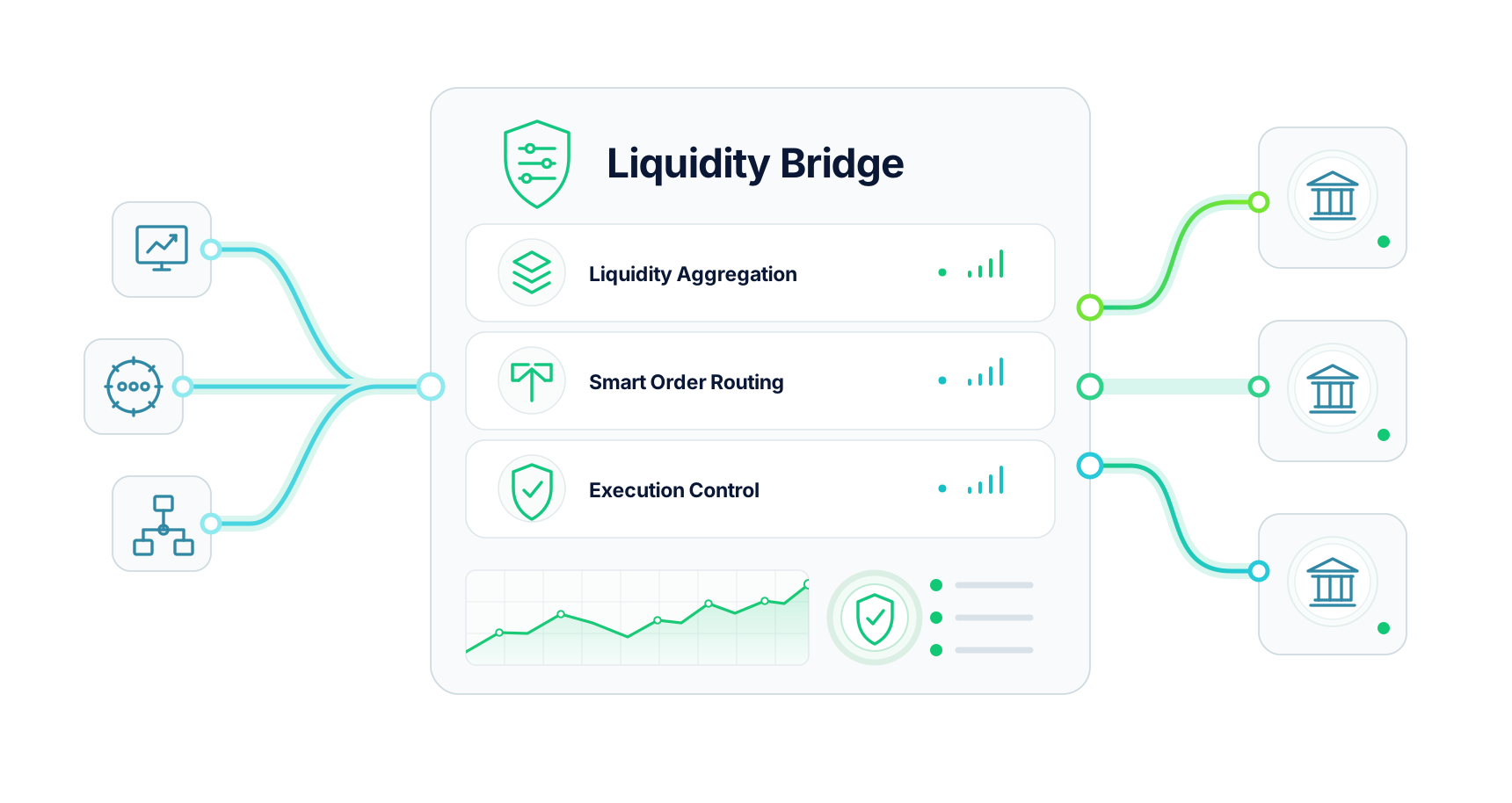
Connect MT4, MT5, cTrader and DXtrade environments with multiple liquidity providers, aggregate market data, and manage routing and execution through one broker-controlled infrastructure layer.
Available on
MT4 MT4
MT5 MT5
cTrader cTrader
DXtrade DXtrade
Liquidity bridge featured image
Multi-Platform Connectivity
Connect MT4, MT5, cTrader and DXtrade.
Multi-Provider Aggregation
Aggregate pricing from multiple liquidity sources.
Flexible Routing
Flexible Routing
Configure your own execution scenarios.
Centralized Control
Centralized Control
Manage pricing, routing, and reporting centrally.
BROKEREE SOLUTIONS

Brokereeโ€™s Liquidity Bridge

Brokeree's Liquidity Bridge connects trading servers with multiple liquidity providers, aggregates their quotes into a single feed, and routes every order according to broker-defined execution rules. Each request can be sent to the best-priced provider, executed in-house, or split between both, with markups, slippage, and client exposure managed from one place.

Key Advantages

01 07
01 / 07

Smart liquidity aggregation

Connect multiple Liquidity Providers

Liquidity Bridge simultaneously connects several liquidity providers to the trading platform and aggregates incoming market data. This way, brokers may achieve the best trading conditions for their clients, providing them with tighter spreads and more competitive prices.

Depth of Market (DoM) feature

The bridge aggregates quotes from all connected liquidity providers and presents them in the Market Watch widget, so brokers may easily evaluate the trading conditions per specific symbol.

The Depth of Market feature provides brokers with detailed information about prices and volumes available for trades. It is especially useful to finetune brokers’ risk management strategy during uncertain market conditions and make informed decisions.

Learn more about hybrid execution

IMPLEMENTATION PROCESS

Launch Your Liquidity Bridge with Brokeree

Deploy Liquidity Bridge around your existing trading infrastructure. Our team helps connect trading servers and liquidity providers, configure execution rules, test the setup, and prepare the solution for launch.

STEP 01

Review Your Infrastructure

Assess your trading servers, existing liquidity connections, execution model, and operational requirements.

STEP 02

Connect Trading Servers

Integrate the required trading environments with the Liquidity Bridge infrastructure.

STEP 03

Connect Liquidity Providers

Establish connectivity with selected liquidity providers and configure the required market data feeds.

STEP 04

Configure Routing and Execution

Set symbols, markups, routing conditions, and applicable A-book, B-book, or hybrid execution scenarios.

STEP 05

Test and Go Live

Validate pricing, order routing and execution flows before launching the configured Liquidity Bridge environment.

Integrated Liquidity Providers

Ausprime

Ausprime

Ausprime provides brokers, hedge funds, and other clients with prime of liquidity services. The company acts as a B2B prime broker that fits the financial regulatory framework of different regions through the MiFID II and CySEC licenses.ย 

Learn more
LMAX

LMAX

LMAX Exchange provides a high-grade market structure and efficient execution to different stakeholders: trading firms, brokerages, funds, banks,etc. The company acts as an FCA-regulated multilateral trading facility and operates with various trading instruments, including FX, metals, commodities, and indices.

Learn more
XTRD

XTRD

XTRD is an orders and execution management system (OEMS) for digital asset trading, providing institutional stakeholders with low-latency and high-throughput execution.

Learn more
Advanced Markets

Advanced Markets

Advanced Markets is a leading provider of prime-of-prime liquidity, offering credit and technology solutions to brokers and asset managers worldwide. The company's range of products supports direct market access (STP) trading in a variety of financial instruments, including Spot FX, metals, energy, and CFDs.

Learn more

Media about us

Brokeree Solutions Integrates Its Liquidity Bridge with cTrader

Brokeree Solutions has enhanced its offerings by integrating its flagship liquidity management solution, Liquidity Bridge, with cTrader, a trading platform developed by Spotware Systems. It is the first partnership between the two companies.

Read article
Advanced Markets Joins Forces with Brokeree Solutions

Advanced Markets, a trusted provider of institutional-grade liquidity, technology, and credit solutions for the forex market, has joined forces with Brokeree Solutions, a developer of comprehensive technology solutions for multi-asset brokers.

Read article
Brokeree Solutions Integrates Its Flagship Liquidity Bridge with Match-Prime Liquidity

Brokeree Solutions โ€“ a developer of turnkey technology solutions for multi-asset brokers announced an integration with Match-Prime, forex and CFD liquidity provider, authorised and regulated by Cyprus Securities and Exchange Commission (CySEC).

Read article
Brokereeโ€™s flagship Liquidity Bridge integrates with XTRD

Solutions developer for multi-asset brokers Brokeree today announced that its Liquidity Bridge will integrate with XTRD, an orders and execution management system (OEMS) for digital asset trading with a focus on low-latency and high-throughput execution.

Read article
Brokeree Solutions Announces Integration of Its Liquidity Bridge with DXtrade CFD Trading Platform

Brokeree Solutions, a turnkey solutions developer for multi-asset brokers, has announced its Liquidity Bridge's integration with DXtrade's CFD trading platform. DXtrade is Devexperts' flagship trading platform for FX, CFD, and cryptocurrency brokers.

Read article
VIDEO INSIGHTS

Learn more about our Liquidity Bridge solution

LIQUIDITY CONNECTIVITY

Liquidity Bridge vs MT5 Gateway

Liquidity bridges and MT5 gateways both connect a broker's trading platform with external liquidity. However, they differ in platform compatibility, infrastructure, liquidity aggregation, routing flexibility, and the number of providers that can be managed.

Multi-Provider
FLEXIBLE LIQUIDITY INFRASTRUCTURE

Liquidity Bridge

A liquidity bridge is an independent infrastructure layer that connects trading platforms with liquidity providers, processes market data and routes trade requests according to broker-defined execution rules.

Connect multiple liquidity providers
Aggregate quotes and market depth
Manage routing rules from one infrastructure layer
Support multiple trading environments, including MT4/M5 and cTrader
Configure A-book, B-book and hybrid execution models
Native MT5
NATIVE MT5 CONNECTIVITY

MT5 Gateway

An MT5 gateway is a native MetaTrader 5 component that connects the trading server directly with a supported liquidity provider and routes orders using rules configured within the MT5 environment.

Native integration with MetaTrader 5
Simpler installation and configuration
Direct connection to a supported liquidity provider
Routing managed within the MT5 infrastructure
Suitable for simpler MT5-only execution setups
CHOOSING THE RIGHT CONNECTIVITY MODEL

When Does a Broker Need a Liquidity Bridge?

An MT5 gateway may be sufficient for a straightforward MT5 setup connected to one supported liquidity provider. A liquidity bridge is better suited to brokers that operate multiple trading servers, connect several liquidity providers, aggregate pricing or require more flexible routing, reporting and hybrid execution controls.

FAQs

Brokereeโ€™s Liquidity Bridge is a comprehensive product that acts as a connector and quotes aggregator between several trading platforms and liquidity providers. The solution is especially useful when operating with multiple quotes or market data sources. It also allows brokers to accurately configure the execution model, combining the advantages of a-book, b-book, and hybrid models.ย 

An MT5 gateway provides native connectivity between MetaTrader 5 and a supported liquidity provider. A liquidity bridge adds a separate infrastructure layer for multi-provider aggregation, centralized routing, reporting and more flexible execution management across broker environments.

By aggregating liquidity from several sources, brokers ensure clientsโ€™ orders are filled on the market with the best trading conditions. The flexible functionality of the Liquidity Bridge allows brokers to accurately configure the execution model based on the quotes from multiple liquidity providers.ย 

Without aggregation, a specific liquidity provider may not have enough volume at the requested price, which results in a worse executed price for the client.ย 

A liquidity provider is a financial institution that acts as an intermediary between the market and market participants, like brokers. It gives them access to market data, quotes, and assets to trade. A liquidity bridge is a technological solution thatย  connects a trading platform and liquidity providers.ย 

Unlike single-connection tools, Liquidity Bridge allows brokers to simultaneously connect to several providers, generate a combined Depth of Market, tighten spreads, and configure the execution model.

A liquidity bridge connects trading platforms to multiple liquidity providers and routes each order according to the brokerโ€™s execution rules. When a trader places an order, the bridge compares quotes across connected providers, including banks and exchanges, selects the most favorable terms, and executes the trade with minimal slippage. Built on protocols like FIX (Financial Information Exchange), it provides direct access to interbank rates and ECNs while reducing counterparty risk through diversified liquidity. This ensures traders using platforms like MetaTrader 4/5 and cTrader benefit from competitive pricing, fast execution, and detailed trade confirmations.

The most common types of liquidity bridges used in trading are ECN and STP.

ECN (Electronic Communication Network) Bridges connect traders directly to a global network of participants, including other traders and institutions. All orders are matched electronically to create a transparent, level playing field with tighter spreads and faster execution.

STP (Straight Through Processing) Bridges route client orders directly to liquidity providers without manual intervention or a dealing desk. The broker passes the order through and earns a commission without influence over pricing or execution. This model reduces conflict of interest and gives traders access to real market conditions across multiple banks and providers.

When choosing a liquidity bridge, consider how effectively it connects with the trading platforms you operate and see if it offers ready integrations with the liquidity providers you plan to connect.ย 

Next, evaluate execution quality and routing flexibility. A capable bridge should provide low-latency processing and smart order routingย  per group, symbol, or account, and adjust rules as your risk profile changes

Also, think about transaction and maintenance costs. Even if setup fees are low, variable pricing models and volume-based fees can eat away your profits over time.
Asset support is also crucial. You want a bridge that gives you access to the specific tokens or instruments your strategy needs. The more assets a bridge supports, the more flexibility youโ€™ll have.

Contact us for pricing