TL;DR
Forex brokers manage risk using three primary execution models:
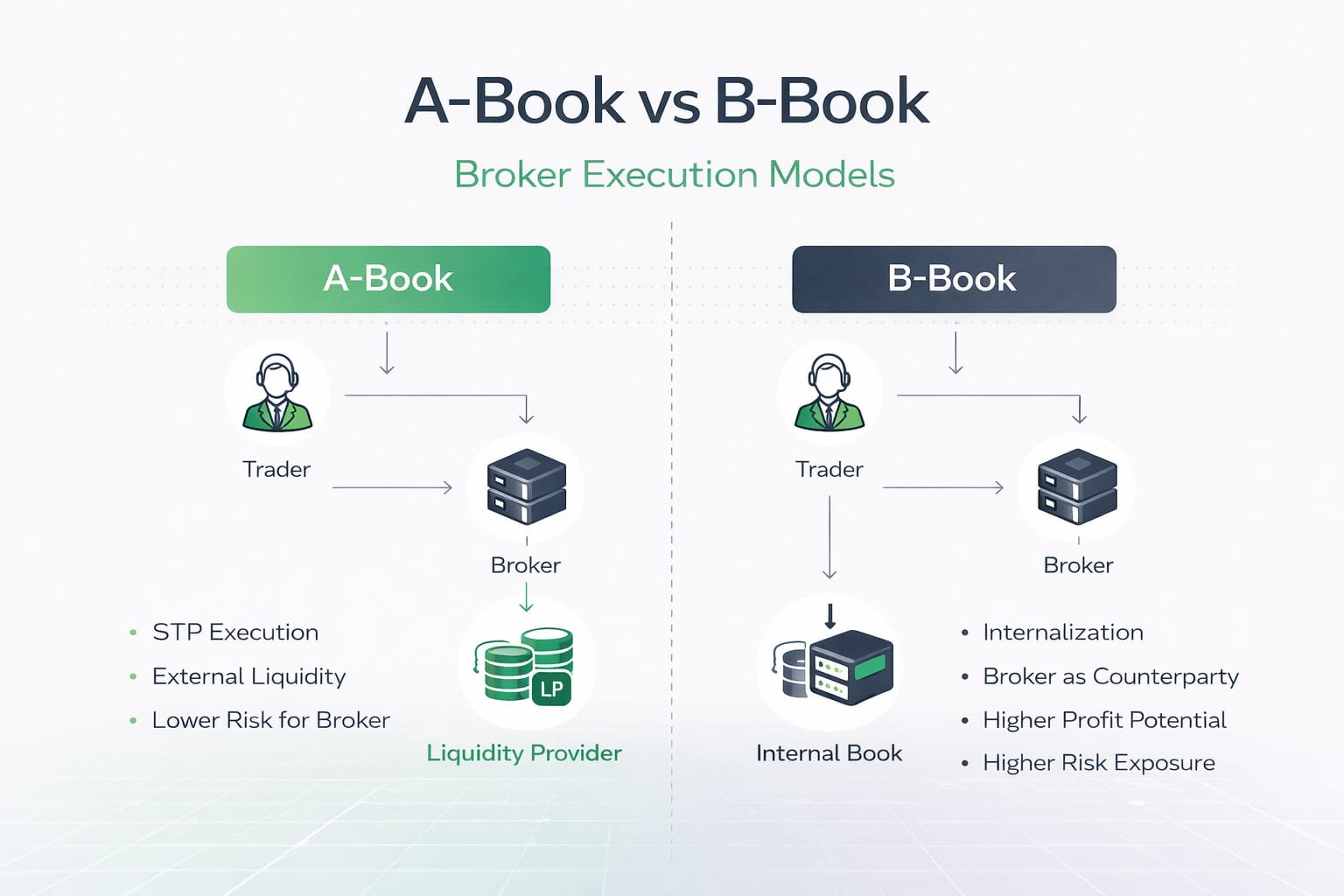
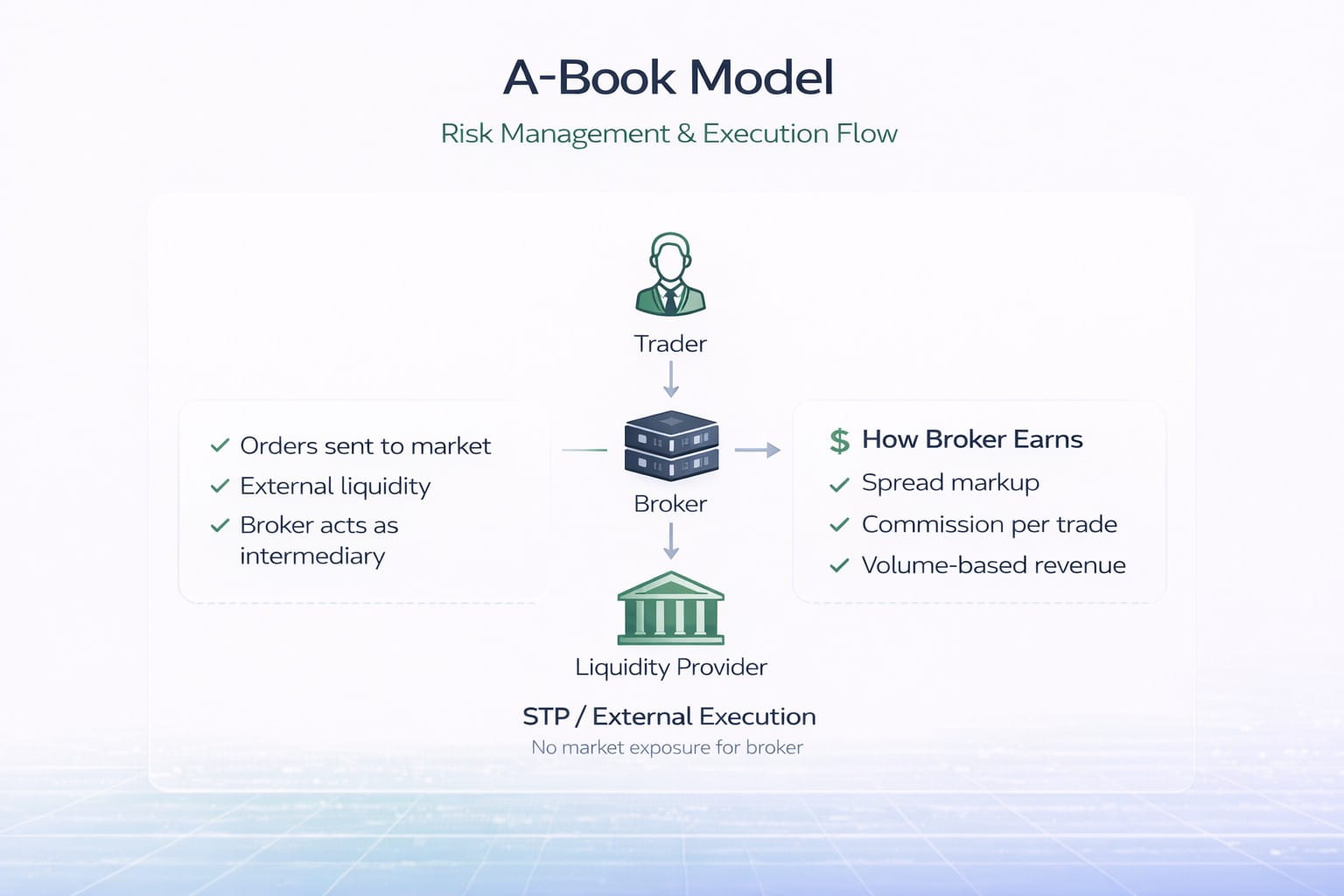
- A-Book (Agency Model): Client trades are passed to liquidity providers. Brokers earn commissions or spread markups and carry minimal market risk.
- B-Book (Market Maker Model): Brokers internalize client trades and take the opposite side of positions. Here, brokers generate revenue through spreads and net internalized flow. They manage risk through hedging and structured risk controls.
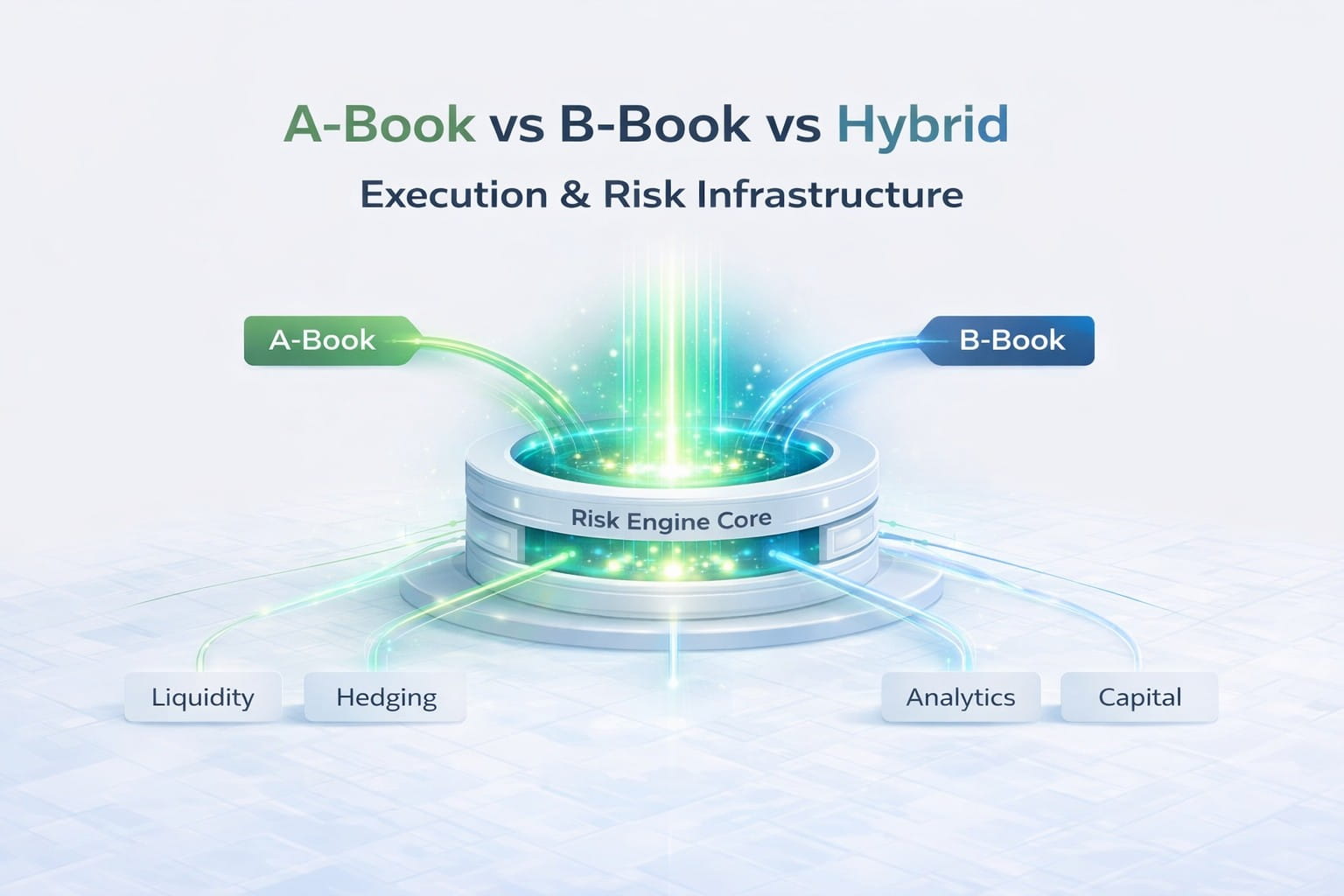
- Hybrid Model: A strategic mix of both, routing some trades externally while internalizing others based on risk profiles.
The right model depends on capital, client profile, trading volume, regulation, and technology infrastructure. Modern brokers rely on bridges, dealing desks, and real-time analytics to balance profitability with client protection.
How Forex Brokers Manage Risk: A-Book, B-Book, and Hybrid Models Explained
Retail forex brokerage is about risk control. Every time a trader opens a position, the broker must ask themselves the following questions:
- Should this trade be passed to the market?
- Should it be kept internally?
- Or should it be partially hedged?
Whatever the answer is determines the broker’s risk exposure.
For example, imagine a broker with 10,000 retail clients trading EUR/USD during a volatile session. If most clients are buying and the market suddenly drops 200 pips, someone absorbs that loss. Depending on the execution model, it may be liquidity providers or the broker.
In the retail and institutional forex brokerage environment, choosing the right execution model directly impacts a broker’s profitability, regulatory positioning, and long-term stability. Whether operating as a market maker (B-Book broker), a Straight Through Processing (STP) broker, or a hybrid structure, the decision shapes how risk is transferred, internalized, or hedged.
This is why the execution model you choose as a broker defines your capital requirements, revenue stability, technology needs, regulatory exposure, and reputation risk. Understanding A-Book, B-Book, and Hybrid models is your first step to expertly managing that exposure.
DID YOU MISS: A-Book vs B-Book: What’s the Difference?
A Note on the A-Book vs B-Book Debate
The A-Book vs. B-Book discussion is often oversimplified. In reality, the distinction is not about “good vs bad” or “safe vs risky.”
A key clarification raised in industry discussions is the difference between:
- Regulatory capital requirements
- Liquidity-side working capital (margin/prefunding with LPs)
When discussing “capital requirements,” it is important to separate statutory regulatory capital from the operational capital required to execute and hedge trades.
For example, a pure A-Book broker may carry minimal directional exposure. But typically must post margin or prefund accounts with liquidity providers and prime brokers. That ties up working capital.
A pure B-Book broker does not need to prefund LPs for every trade. But must maintain sufficient capital buffers to absorb aggregate client P&L swings and tail-risk events.
In other words, someone always holds the risk. The real question is how that risk is managed, capitalized, and disclosed.
This article focuses on execution mechanics and operational capital. Not legal capital thresholds, which vary by jurisdiction.
A-Book vs B-Book vs Hybrid: Definitions Explained
A-Book Model (Agency / STP Risk Transfer)
In the A-Book model, brokers transfer client trades directly to liquidity providers (LPs). This can be banks or non-bank market makers. When a client buys 1 lot of EUR/USD, the broker simultaneously enters an identical trade with a liquidity provider. That way, the broker earns commission per lot traded and spreads markup.
Because client trades go to external liquidity providers, the broker minimizes direct directional risk. However, A-Book execution still involves operational, counterparty, margin, and execution risks. These risks often come during periods of extreme volatility or reduced market liquidity.
This model is commonly associated with Straight-Through Processing (STP) brokers and Electronic Communication Network (ECN) brokers.
Strengths:
- Reduced direct directional market exposure;
- Access to institutional liquidity;
- Transparent pricing.
While A-Book brokers reduce directional exposure, they are still exposed to:
- Counterparty risk (LP default or execution failure);
- Slippage and liquidity gaps;
- Margin calls from prime brokers;
- Negative balance events in extreme volatility.
The 2015 Swiss National Bank (SNB) event is a widely cited example. When the EUR/CHF floor was removed, liquidity evaporated. A-Book brokers like FXCM suffered as liquidity providers stopped providing pricing during the event. This resulted in some clients having negative balances, as there was no way to execute stops in time. The broker ended up on the hook for those negative balances. A-Book reduces client-risk conflict, but it does not eliminate operational or counterparty risk.
B-Book Model (Market Maker/Internalization)
In the B-Book model, the broker takes the opposite side of client trades. If a client buys EUR/USD, the broker actually sells it to them internally. Trades remain “in the broker’s book.”
Brokers get revenue from spread income and net internalized flow. While retail trading outcomes vary statistically across client segments, brokers actively manage their risk through hedging strategies, position netting, and predefined risk limits to maintain capital stability.
Unlike STP or ECN models, a dealing desk broker internalizes order flow and manages exposure internally, often referred to as the market-maker model.
Strengths:
- Faster internal execution
- Stable spreads
- Potentially higher margins
Risks:
- Direct market exposure
- Conflict-of-interest perception
- Regulatory scrutiny
Consider a broker with $50M in client exposure during a strong bullish move. If most clients are long and profitable, the broker must pay those profits. Without proper hedging or segmentation, this can quickly affect capital reserves.
B-Book profitability relies heavily on disciplined risk management. This skill involves risk monitoring and the broker’s ability to hedge strategically when aggregate risk exceeds predefined limits.
Hybrid Model (Selective Routing / C-Book)
The Hybrid model combines A-Book and B-Book strategies. Here, brokers analyze client behavior and segment traders.
Hybrid execution is not a fixed three-bucket system. It is a dynamic risk allocation framework. Modern brokers do not segment clients once and leave them there. Instead, routing decisions are continuously adjusted based on:
- Real-time net exposure per instrument;
- Client profitability over rolling periods;
- Order size relative to available liquidity;
- Volatility regime (calm vs stressed markets);
- Correlation risk across instruments;
- Margin utilization and capital thresholds.
For example, a trader may be internalized during low volatility but automatically hedged during high-impact news events. Likewise, exposure may be partially offset when instrument-level concentration exceeds predefined risk limits.
Hybrid execution, therefore, is not about labeling traders. It is about managing aggregate risk dynamically across time, instruments, and market conditions.
Strengths:
- Flexible risk allocation across client segments;
- Improved margin efficiency vs pure A-Book;
- Reduced tail exposure vs pure B-Book;
- Revenue diversification (commissions + internalized flow);
- Dynamic routing during volatility events.
Risks:
- High infrastructure complexity;
- Requires advanced analytics and real-time monitoring;
- Mis-segmentation risk (misclassifying profitable flow);
- Operational failure risk during volatility spikes;
- Regulatory scrutiny if the routing logic lacks transparency.
Hybrid execution is often misunderstood as a static “split.” In practice, it is a continuous, real-time risk balancing mechanism. Without structured analytics and automated routing controls, hybrid quickly becomes unmanaged exposure.
How Brokers Choose a Risk Model Based on Volume, Region, and Pricing
Choosing A-Book vs. B-Book, or going hybrid, is strategic and has to be guided by certain factual metrics.
1. Trading Volume
- High institutional volume: A-Book preferred
- Small retail tickets: B-Book often viable
- Mixed flow: Hybrid execution
High-volume professional traders demand tight spreads and market execution. Retail traders often prioritize simplicity and fixed spreads.
2. Regulatory Environment
In highly regulated regions (EU, UK, Australia), transparency and reporting requirements may push brokers toward A-Book or controlled hybrid setups.
In offshore or emerging markets, B-Book remains common due to lower capital thresholds and flexible pricing structures.
3. Pricing Strategy
- Commission-based model: Often A-Book
- Fixed spreads: Often B-Book
- Variable pricing with segmentation: Hybrid
4. Capital and Risk Appetite
A-Book execution typically requires posting margin or prefunding with liquidity providers and prime brokers. This ties up liquidity-side working capital, even if directional market exposure is reduced.
B-Book execution removes the need to prefund external LPs for every trade. However, it requires maintaining sufficient capital buffers to absorb client P&L volatility and extreme market events.
Hybrid models combine both capital dynamics and, therefore, demand disciplined capital allocation frameworks.
Regulatory capital requirements are jurisdiction-specific and different from execution-side capital considerations. The right question isn’t “Which model is best?” Instead, it is “Which model aligns with your capital, clients, and level of infrastructure growth?”
Tools that Support Forex Broker Risk Management
Execution models are strategic decisions, but technology makes them possible.
1. Liquidity Bridges
Liquidity bridges are the core execution infrastructure for the best forex brokerage setups. They connect trading platforms (MT4, MT5, cTrader) to external liquidity providers and enable:
- Real-time order routing
- Multi-LP price aggregation
- Risk monitoring and offsetting
- Spread and markup configuration
- Dynamic hybrid execution logic
Without a robust bridge, brokers cannot efficiently control routing decisions between internalization and external hedging. In hybrid environments, bridges act as the technical layer that translates risk policy into executable routing logic.
Solutions like Brokeree Liquidity Bridge provide institutional-grade routing control. They help brokers to execute structured A-Book, B-Book, and hybrid strategies accurately and at scale.
ALSO READ: Liquidity Bridge is the Ultimate Solution for A-Book, B-Book, and Hybrid Models
2. Dealing Desk and Internalization Engines
For B-Book operations, brokers rely on exposure monitoring, net position tracking, automated hedging triggers, and real-time risk dashboards.
These tools allow brokers to monitor aggregate exposure and hedge selectively when risk limits are exceeded.
3. Risk Analytics and Segmentation Systems
Hybrid execution depends on data. Brokers need to analyze client profitability patterns, trading frequency, instrument exposure, and volatility sensitivity.
Fortunately, with advanced analytics, you can determine whether trades should be fully hedged, partially hedged, or internalized. This is where infrastructure becomes non-negotiable.
Best Practices for Balancing Business Performance and Client Protection
As a broker, when deciding your risk management model, you don’t only consider profitability. Sustainability is just as important. The best brokers follow these principles:
1. Segment Clients Intelligently
Avoid blanket internalization. Only use data-driven segmentation.
2. Avoid Extreme Concentration Risk
Always monitor instrument-level exposure.
3. Maintain Liquidity Relationships
Even B-Book brokers should maintain LP connections for hedging flexibility.
4. Prioritize Transparent Pricing
Reputation risk can outweigh short-term margin gains.
5. Invest in Infrastructure
Hybrid execution without analytics is speculation. But hybrid execution with structured routing logic is strategic. The goal here is balance. Ensure you can protect capital while still maintaining client trust and preserving long-term revenue stability.
Transparency and the “Who Holds the Risk?” Question
An important concern raised in discussions is whether an A-Book broker routes to a liquidity provider and that LP internalizes the flow, then who ultimately carries the risk?
The execution chain can extend across multiple layers of internalization and hedging. At some point, risk stays on someone’s balance sheet.
This is why the real evaluation metric is not simply: “Are you A-Book or B-Book?” Instead, sophisticated traders and partners increasingly ask:
- Is the broker well-capitalized?
- Is execution transparent?
- Are routing policies structured and disclosed?
- Are risk controls automated and auditable?
Model labels matter less than balance sheet strength, governance, and infrastructure integrity.
Conclusion: Infrastructure Determines Risk Outcomes
- A-Book minimizes directional risk but makes your brokerage dependent on counterparty and execution accuracy.
- B-Book can improve margin efficiency, but it also increases internal risk.
- Hybrid models add flexibility to your operations but demand precise execution control.
The fit and ability of any forex brokerage’s infrastructure determine whether execution risk remains under control or becomes a systemic vulnerability.
It’s best when execution architecture supports real-time risk monitoring, dynamic routing, multi-LP aggregation, internalization control, and automated hedging triggers. When your brokerage lacks this foundation, even well-designed risk models can fail under stress conditions.
Brokeree Solutions delivers institutional-grade execution infrastructure designed to support A-Book, B-Book, and Hybrid forex brokerage models within a unified ecosystem. For brokers scaling across jurisdictions, expanding product offerings, or refining internal risk controls, infrastructure determines resilience.
Frequently Asked Questions About Forex Broker Risk Models
-
What is the difference between A-Book and B-Book execution?
A-Book brokers transfer client trades to liquidity providers and earn commissions or spread markups. B-Book brokers internalize trades and profit from spreads and net client losses while assuming market risk.
-
What is a Hybrid (C-Book) model in forex brokerage?
A Hybrid model combines A-Book and B-Book execution. Brokers selectively route some trades to liquidity providers while internalizing others based on risk segmentation and profitability analysis.
-
Which risk model is most profitable for brokers?
Profitability depends on client mix, trading volume, capital reserves, and infrastructure. Hybrid models often provide balanced revenue streams but require advanced technology.
-
Is B-Book execution illegal?
No. B-Book execution is legal when transparently disclosed and properly regulated. However, it requires strong risk management and compliance oversight.
-
Why do most brokers use hybrid execution today?
Hybrid models allow brokers to manage exposure dynamically, reduce extreme risk events, and optimize revenue by combining commission income with internalized flow.