KYC has always been a fundamental part of brokerage operations. But with stricter regulatory requirements the pressure on brokerages to modernize their KYC processes has significantly increased.
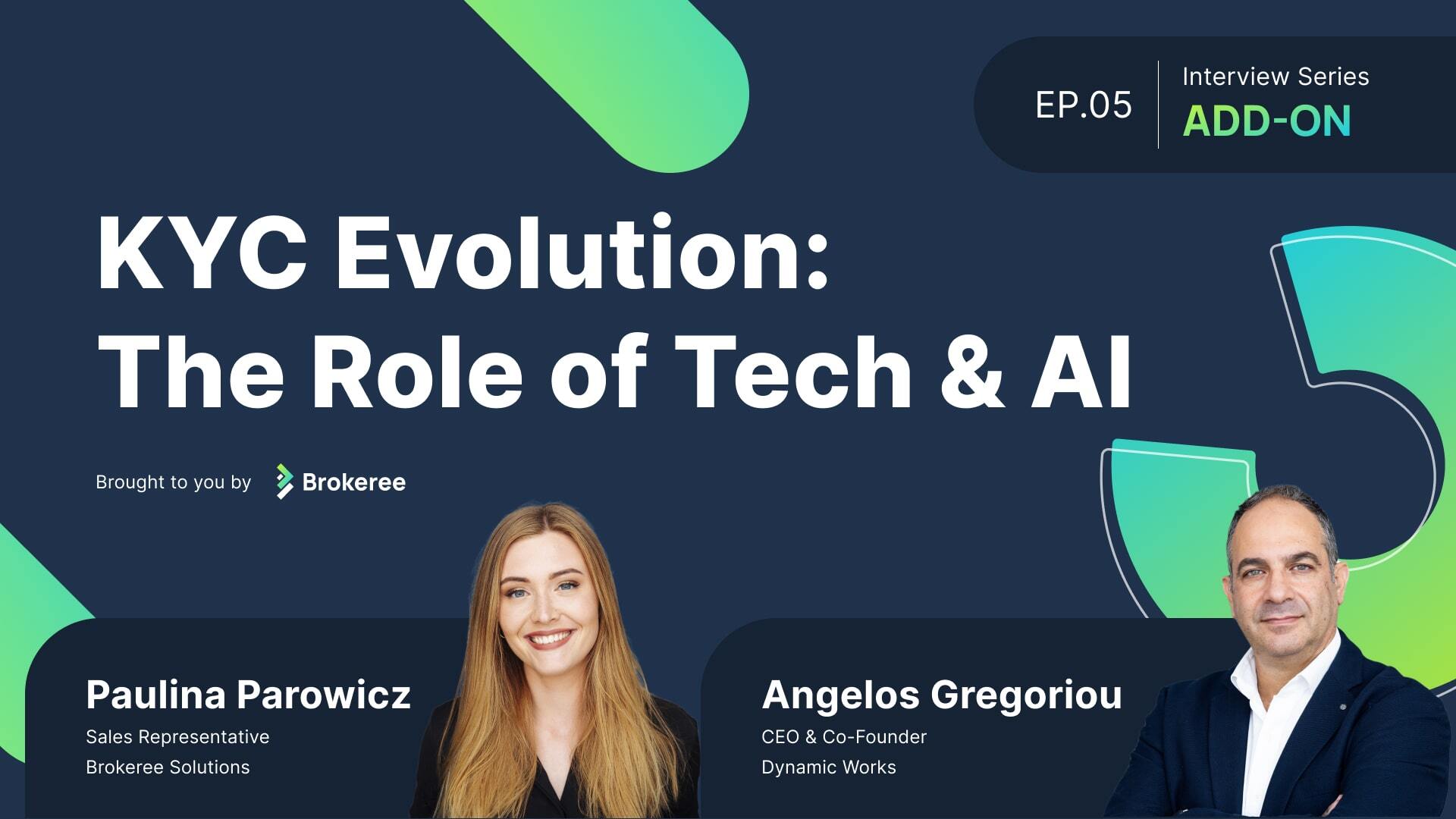
In the latest episode of Brokeree Add-on Interview Series, host Paulina Parowicz sits down with the CEO of Dynamic Works, Angelos Gregoriou, to explore how KYC is evolving and how technology is stepping up to meet today’s security and compliance demands.
Below is the summary and the key talking points of this episode. For full conversation and insights from Angelos Gregoriou, check out the episode on Brokeree YouTube channel.
Why is KYC such a foundation for brokerages?
KYC is not something that’s just good-to-have. If you are a broker and you want to prevent fraud, it is a must, a priority.
Fraud is one of the biggest sources of financial damage for brokerages; therefore, modern KYC systems are designed not just to verify documents, but to detect behavioral anomalies, prevent abuse of promotional systems, and safeguard both the broker and the trader. In short, KYC is essential for two main reasons:
- Fraud prevention: Brokers face increasing threats from duplicate accounts and identity scams.
- Regulatory compliance: Regulators now mandate eKYC systems, making them a legal necessity rather than a nice-to-have.
What is eKYC, and how has it evolved?
eKYC refers to the digital process of verifying identity documents and confirming their authenticity. In earlier generations, users uploaded photos of IDs, and teams manually reviewed them. Now, AI has become integral to modern eKYC.
While eKYC has existed for years, AI now makes it more intelligent, adaptive, and resilient to fraud attempts. As ‘users have learned tricks’ and scammers get more sophisticated, technology that detects them also has to become more intelligent.
What are some of the key challenges brokerages face today when it comes to KYC?
Brokers often face several challenges in managing client onboarding and compliance, from integrating multiple third-party systems to verifying complex and inconsistent documents. These hurdles can slow down operations, increase costs, and create friction for both compliance teams and traders. Taking the above into account, there are a few challenges brokers face:
- Integration complexity: If a broker has to go to multiple providers with separate systems and those providers need to be integrated with their chosen KYC provider, these integrations could become time-consuming, expensive, and technically complex since the processes are not always straightforward due to compatibility, custom development and ongoing maintenance to keep all systems synchronized.
Dynamic Works is aiming to solve this challenge by introducing eKYC as a native functionality of the system. Instead of trying to integrate multiple identity verification tools or building workflows manually, brokers can rely on a single unified system that handles verification, documentation, and compliance checks in one place.
- User onboarding experience: Traders want fast approvals. A system that extracts data automatically, instead of requiring manual form-filling, speeds up the onboarding process without compromising compliance.
- Proof of Address Verification: There are countless document types worldwide, each formatted differently and often containing multiple addresses, some belonging to the user and others to the utility provider. Many of these documents are even handwritten. This makes it hard to rely on fixed templates or traditional approaches. In this case, AI helps by intelligently identifying and extracting the correct name and address, simplifying the process for compliance teams.
How do technologies like NFC, liveness checks, and voice analysis fit into KYC?
These innovations make KYC faster, safer, and more reliable. Modern IDs and passports now include NFC chips containing verified digital identity data. Using NFC during onboarding allows for:
- Faster scanning;
- Near-zero data extraction errors;
- More accurate identity matching during liveness checks.
On the other hand, AI-driven liveness tests confirm that the user is physically present (not a photo or video spoof).
Additionally, voice analysis is used in call monitoring, ensuring compliance in broker-client communications, detecting fraud patterns, and improving customer interactions.
Lastly, proof-of-address verification has historically been difficult due to document format variability. AI now helps:
- Detect names and addresses even on unstructured documents.
- Separate user addresses from company addresses.
- Interpret handwritten documents.
This reduces manual review time for compliance teams.
Can current systems still detect fraud, given how advanced scams are becoming?
The short answer is “Yes!” Fraud detection remains effective because systems compare multiple verification layers:
- Compare MRZ codes with NFC chip data for document integrity
- Track login patterns, IP changes, and transaction behavior.
- Trigger alerts for suspicious withdrawals or unusual user activity.
Alerts warn compliance teams before risky transactions are processed.
Will adding more security layers slow down onboarding for traders?
Surprisingly, the answer is — no! In fact, advanced and well-designed KYC systems remove certain steps, therefore speeding up the onboarding process.
Instead of typing personal information, the system can extract data directly from the scanned ID, making onboarding faster and smoother for the trader. Traders can verify and start trading in minutes, while compliance remains airtight.
Will these tools and systems affect compliance teams and their responsibilities?
Automation will ease the workload of compliance officers, allowing them to focus on higher-level tasks rather than repetitive document checks.
While efficiency will increase, compliance departments remain essential. Technology simply optimizes their processes.
What’s Next for KYC?
There might be a shift toward identity-based sign-ins using NFC-enabled IDs instead of social or email logins. This would create a universal digital identity that is secure, portable, and verifiable, which is a major step forward in global compliance and cybersecurity.
Lastly, what would be the advice for brokers who want to modernize their KYC processes?
It is important to remember that modern KYC doesn’t just protect the broker. It improves customer satisfaction and, what’s even more important, trust between brokers and traders. To support this process:
- Choose fully compliant, reliable verification systems.
- Focus on both security and user experience.
- Use automation to free teams from repetitive manual checks.
In conclusion:
- Most global financial regulators now require or formally accept eKYC and digital identity verification, with over 80% already mandating or permitting it and the rest actively transitioning toward the same standards.
- AI and NFC technologies are transforming eKYC, making verification faster, more accurate, and harder to manipulate.
- Integrated compliance systems reduce complexity for brokers by embedding eKYC natively. See how Dynamic Works can support this process.
- Voice and behavioral analytics add new layers of security and compliance oversight.
- Automation enhances human roles, e.g., compliance officers can focus on strategy rather than routine checks.
- The future of KYC may rely on digital identities embedded in NFC-enabled IDs, bringing universal verification closer to reality.
For more insights, watch the full episode of the Brokeree Add-On Interview Series with Angelos Gregoriou, CEO & Co-Founder of Dynamic Works.
About the guest: Angelos Gregoriou, CEO & Co-founder | Dynamic Works
Angelos Gregoriou, CEO and co-founder of Dynamic Works, a company renowned for creating Syntellicore, an award-winning platform for the financial industry, leads with a focus on innovation in FinTech and CRM applications. With a strategic vision and hands-on leadership, Angelos has positioned Dynamic Works at the forefront of FinTech innovation and next-generation CRM solutions.
About Brokeree Solutions
Brokeree Solutions is an international provider of technological solutions for multi-asset brokers worldwide. With 11 years of industry expertise, the company specializes in turnkey solutions development, trading platform servicing, and consultation for retail brokers using MetaTrader 4, MetaTrader 5, cTrader, and DXtrade CFD trading platforms. Brokeree Solutions’ extensive product portfolio includes flagship systems like Social Trading, PAMM, Prop Pulse, and Liquidity Bridge, offering comprehensive technologies that address almost any broker’s needs.
______________
Curious to learn more?
Don’t forget to subscribe to our channel for more insights on the latest fintech innovations. Watch the full episode of Brokeree’s Add-on Series on YouTube for the complete conversation, real-world examples, and expert tips!