TL;DR:
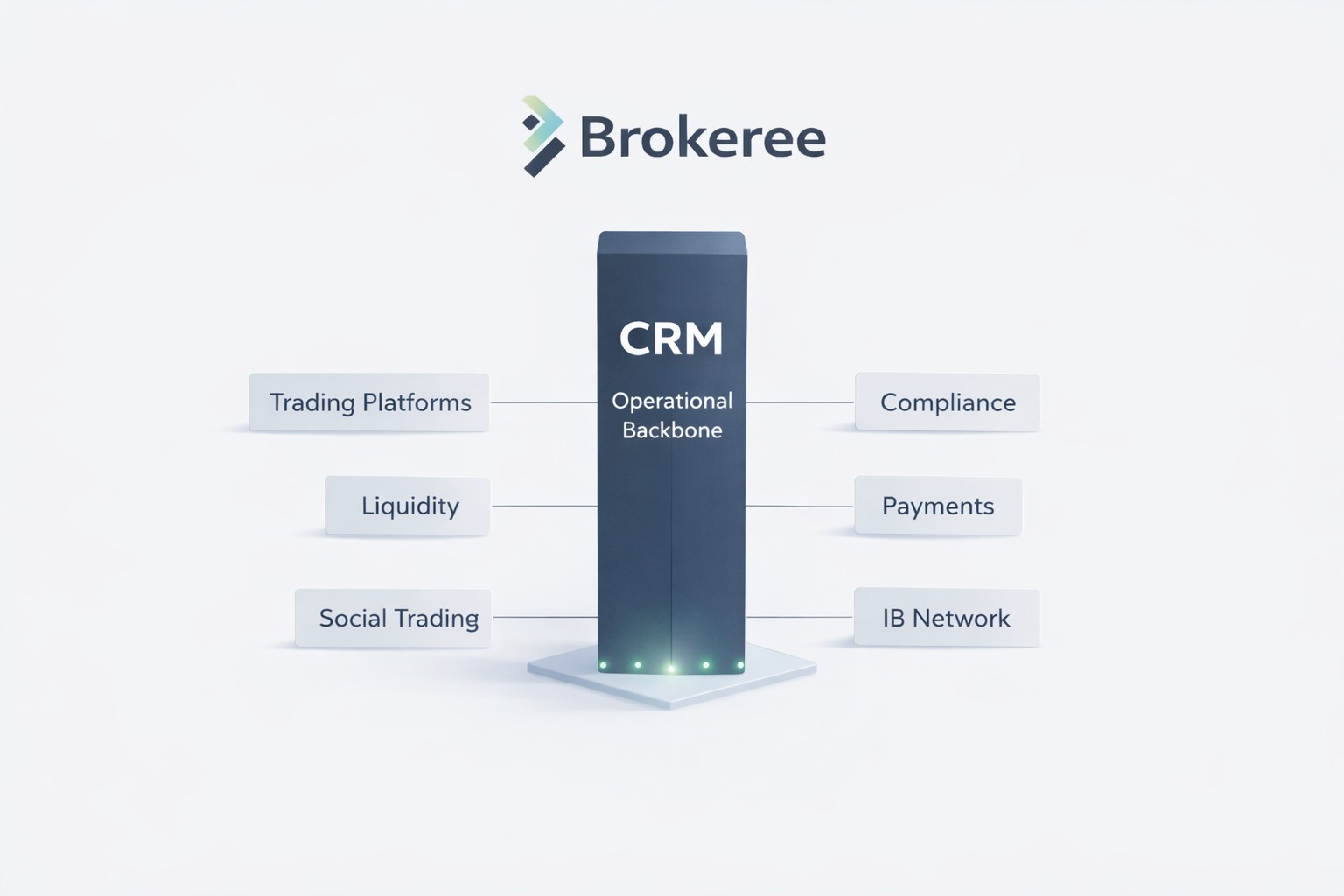
A CRM for forex brokers is the operational backbone of your brokerage. It orchestrates workflows and synchronises data from trading platforms, compliance systems, payments, and IB networks.
Unlike generic CRMs, a forex brokerage CRM system focuses on your platform’s regulation, automation, platform integration, and trading data.
When choosing the right CRM, focus on infrastructure fit, scalability, compliance readiness, integration depth, and ecosystem compatibility. It’s never about the features alone.
CRM for Forex Brokers: Why It Matters and What Features to Look For
Running a forex brokerage today is no longer just about spreads, leverage, and liquidity. Brokers now run full digital frameworks. So, a CRM for brokers in this new age must support onboarding, compliance, payments, trading platforms, IB networks, retention programs, and client support simultaneously.
Without a central system, everything quickly falls apart. Client data in one place, trading data in another, KYC in another, payments in another, and your marketing tools somewhere else.
No one wants that operational friction. It leads to poor visibility, slow decision-making, and inconsistent client experiences.
This is where a forex broker CRM becomes critical. It connects workflows, data, and operations across your brokerage stack.
A forex CRM pulls together client information, trading activity, compliance workflows, payments, and partner management into a single central operational layer. That structure alone takes you from being a brokerage that reacts to problems to one that is intentional about its growth.
CRM as the Operational Backbone of a Forex Brokerage
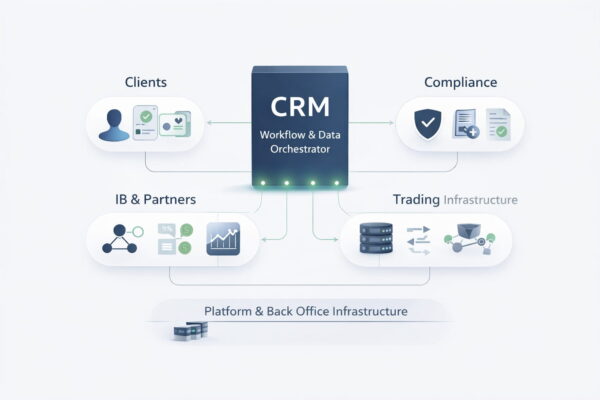
In the ideal brokerage environment, a CRM is not a tool for one department. It’s an entire infrastructure that connects:
- Clients through onboarding, KYC, accounts, and lifecycle stages;
- IBs and partners by tracking referrals, commissions, performance, and payouts;
- Compliance with verification, audit trails, reporting, and regulatory workflows;
- Trading infrastructure through platforms, execution systems, social trading, PAMM, and copy trading.
Note, for a forex CRM, the platform servers and back-office systems handle trading account creation, execution logic, and account management. The CRM also handles the workflows, synchronises data via APIs, and manages lifecycle logic. However, it does not replace platform infrastructure.
ALSO READ: PAMM vs. MAM: What Brokers Need to Know Before Choosing a System
Picture a broker onboarding a new client. The CRM automatically does the heavy lifting.
- Prompts KYC verification;
- Initiates trading account creation on MT4/MT5 via platform API;
- Links payment methods through the client cabinet and PSP integrations;
- Tracks trading behaviour;
- Assigns the client to lifecycle segments.
Why Forex Brokers Need a Forex Brokerage CRM System (and Why Generic CRMs Don’t Fit)
Generic CRMs are created to boost sales pipelines, emails, and customer support tickets. But it is a different need with broker workflows.
A forex broker needs a CRM to handle:
- Trading account structures;
- Regulatory compliance flows;
- AML screening integration (e.g., Sumsub, Shufti, ComplyAdvantage);
- Multi-currency environments;
- Platform data synchronisation;
- Partner hierarchies;
- Trading behaviour analytics;
- Financial reporting logic;
- Consent management and audit trails.
Generic CRMs lack native brokerage domain models, real-time trading integrations, and compliance workflows required for regulated forex operations.
Therefore, the right CRM for forex brokers goes beyond generic customer management. It understands and efficiently handles financial operations.
Essential Forex CRM Features for Forex Brokers
A helpful trading CRM for brokers must cover four operational pillars:
-
KYC and Regulatory Compliance
This involves automated onboarding, document verification, jurisdictional compliance logic, audit trails, and reporting tools.
-
Client Segmentation and Lifecycle Management
They group clients based on behaviour, lifecycle stage, risk profile, and activity levels.
-
IB and Partner Management Systems
The CRM system handles referral tracking, commission logic, partner hierarchies, automated payouts, and performance reporting.
-
Retention, Engagement, and Client Value Tracking
Forex brokers need a CRM to monitor inactivity, churn risk, trading frequency, funding behaviour, and engagement patterns.
Forex CRM Integration in a Forex Broker Tech Stack
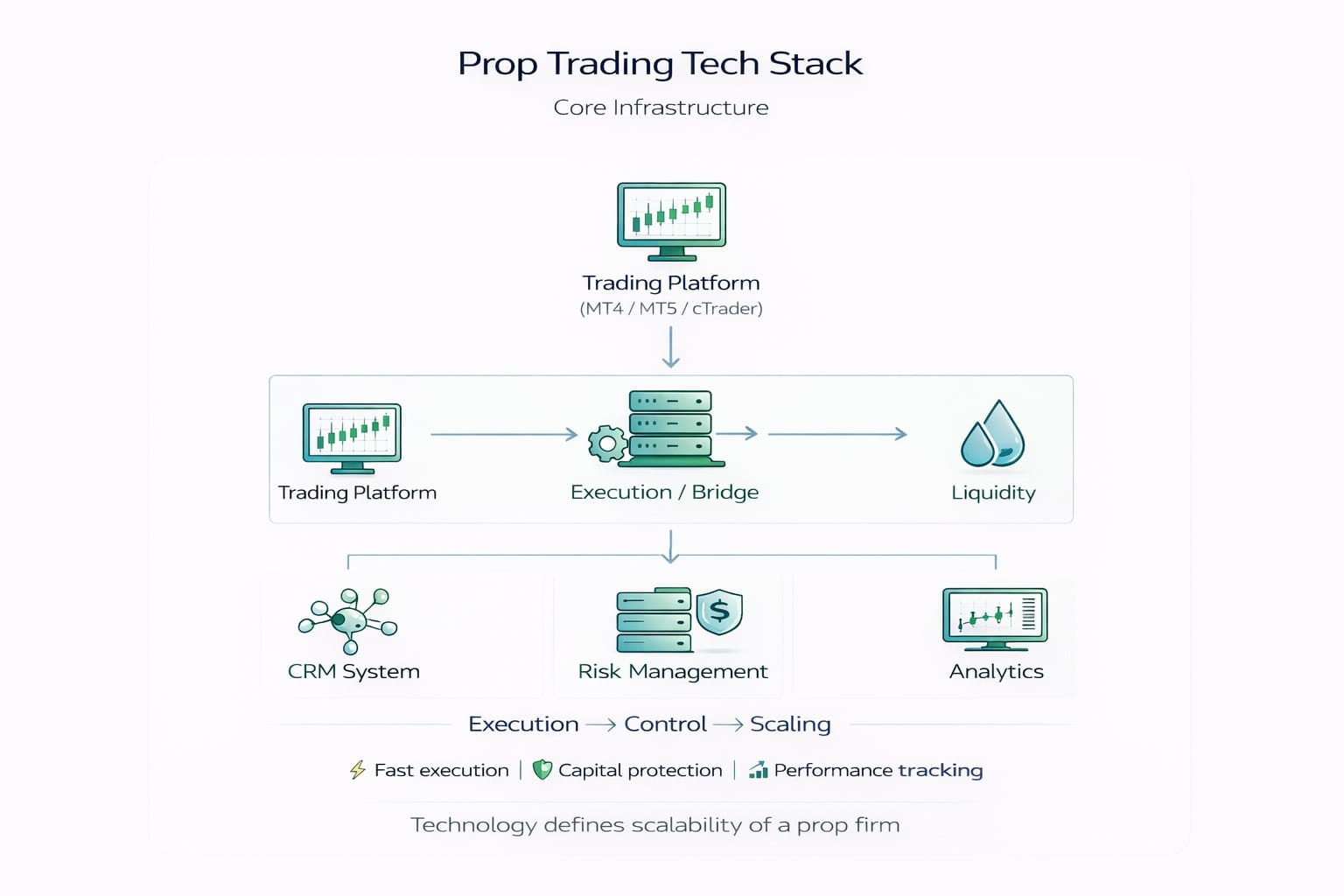
A CRM only works if it integrates seamlessly with the rest of the brokerage infrastructure. These other parts include:
- Trading platforms: MT4, MT5, cTrader;
- Liquidity & execution: routing systems, bridges, aggregators;
- Payments: PSPs, crypto gateways, regional providers;
- Compliance tools: KYC, AML, sanctions screening;
- Marketing tools: email systems, analytics platforms;
- Trading services: social trading, PAMM, copy trading.
This is where forex CRM integration becomes more important than CRM design itself. Brokers building long-term infrastructure should never handle CRM decisions in isolation.
It isn’t the payment processor, trading platform, or client cabinet. It is the data, workflow, and orchestration layer that connects them all.
The right question is not “Which CRM is best?” It is “Which CRM integrates cleanly into your execution, trading, compliance, and growth architecture without creating future migration risk?”
Security, Compliance, and Data Privacy in CRM for Regulated Forex Brokers
The forex brokerage market is highly regulated. Hence, it’s necessary that the CRM you choose supports:
- Regional regulatory compliance;
- Role-based access control;
- Data encryption;
- Audit logs;
- Activity tracking;
- Reporting transparency;
- Scalable architecture;
For brokers who prioritize regulatory compliance, a CRM goes from an operational infrastructure to a legal one.
How to Choose CRM for Forex Brokers Based on Business Model and Scale
Choosing a CRM is not about choosing the “best software.” It’s about finding the best infrastructure fit.
As a startup broker, your best fit should offer speed, core integrations, compliance readiness, and scalability. Growing brokers should focus on automation, data visibility, retention systems, and platform integrations. Regulated brokers must prioritize compliance depth, auditability, reporting, and data control. Finally, the best CRM for offshore brokers is one that offers flexibility, integration, scalability, and modularity
The right CRM for you is the one that fits your brokerage business model, regulatory exposure, and scale trajectory. That is what you look for when checking out the feature list.
| Broker Type | CRM Priority | Risk If Wrong Choice |
| Startup Broker | Speed, Integration, Scalability | Costly migrations, broken growth |
| Growth Broker | Automation, retention systems | Operational bottlenecks |
| Regulated Broker | Compliance, reporting, auditability | Regulatory exposure |
| Enterprise Broker | Infrastructure fit, ecosystem integration | Platform fragmentation |
CRM Integration with Brokeree Solutions
Brokeree’s flagship technologies, including Social Trading, PAMM, Prop Pulse integrates with industry-leading CRM providers and back-office systems, such as Skale, FX Back Office (FXBO), EAERA, Syntellicore, and AXIS.
Brokeree does not store or control CRM data. Data ownership remains on the CRM/back-office side.
A CRM integrated with Brokeree connects:
- Trading platforms (MT4, MT5, cTrader);
- Trading services: copy trading, prop trading, PAMM;
- Client Acquisition and onboarding systems;
- Compliance and risk tools;
- Partner and IB systems;
- Payments and operational tools.
Brokeree’s approach positions CRM as part of a modular, connected brokerage infrastructure.
This setup allows brokers to:
- Scale without system fragmentation;
- Maintain regulatory control;
- Integrate trading services;
- Centralize operational visibility;
- Build enterprise-grade ecosystems.
Learn more about Brokeree’s CRM integrations
Closing Thoughts
Growth-driven brokers designing institutional-grade infrastructure choose the right CRM by focusing on architecture, not features. The integration depth, platform compatibility, regulatory readiness, and scalability determine whether a CRM helps your brokerage grow or become a bottleneck.
With Brokeree Solutions, CRM is treated as an infrastructure connector. Here, it links trading platforms, execution systems, social trading, PAMM, and client operations into one scalable operational layer.
If your brokerage is scaling beyond basic operations and into enterprise-grade infrastructure, your CRM should no longer be treated as client software. It must align with your execution, trading, and compliance architecture.
Choose a CRM that integrates into your brokerage setup. Not one you’ll need to replace when scale exposes its limits.
FAQs
Q1: What is a CRM for forex brokers?
A CRM for forex brokers is a specialized system that manages client data, compliance, trading integration, payments, partner programs, and operational workflows. They are built specifically for brokerage environments.
Q2: Why can’t brokers use generic CRMs?
Generic CRM systems don’t support trading platforms. They don’t understand the compliance workflows, partner hierarchies, or financial reporting structures required in brokerage operations.
Q3: What are the most important forex CRM features?
Key features include KYC automation, platform integration, IB management, client segmentation, lifecycle tracking, compliance reporting, and scalability.
Q4: How does CRM support copy trading and PAMM?
CRM is the central hub. It connects clients, strategies, payments, and trading services into one interface. The right CRM enables seamless user journeys and visibility for your brokerage.
Q5: Is CRM important for regulated forex brokers?
Yes. CRM is essential for compliance workflows, audit trails, reporting, data security, and regulatory transparency.