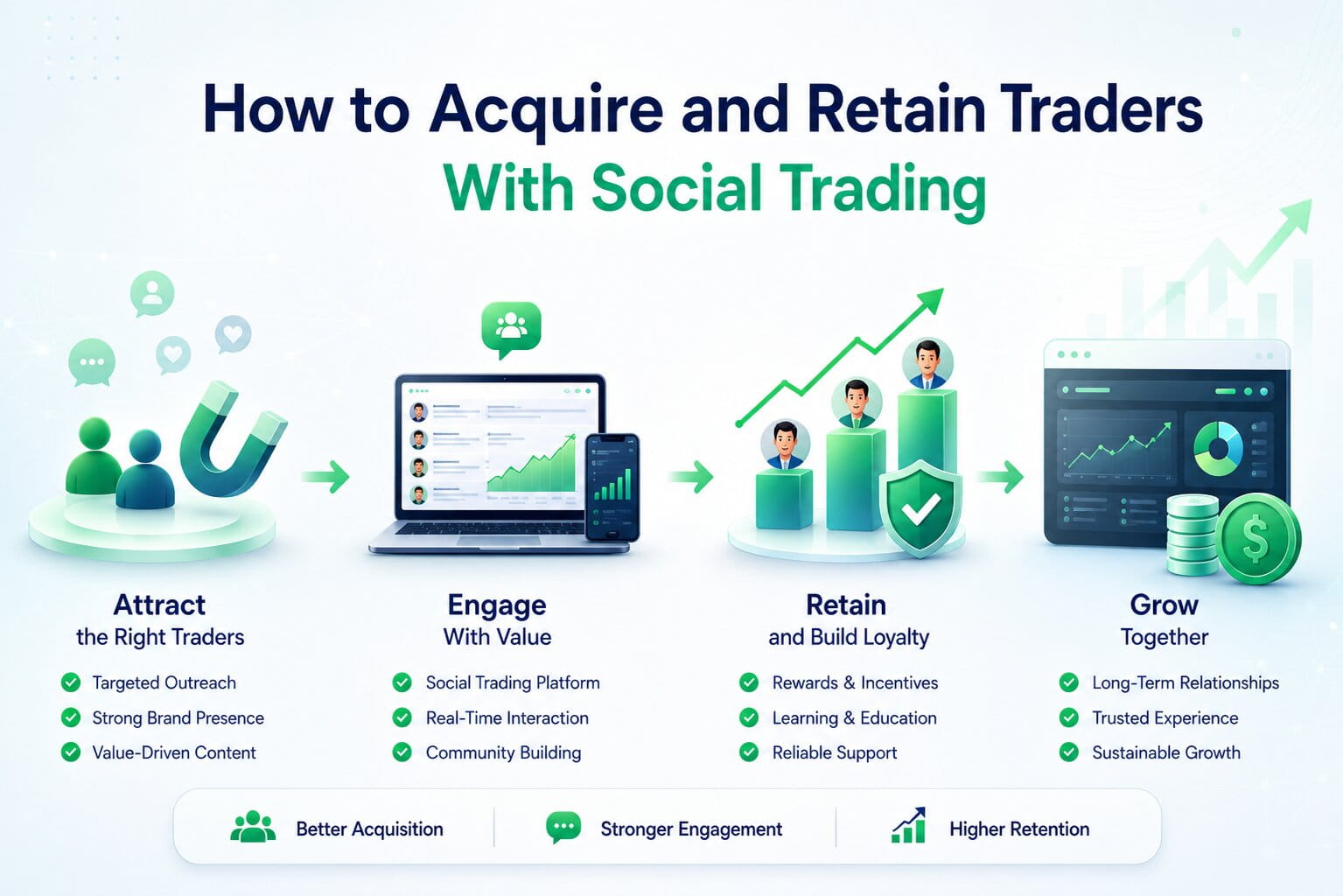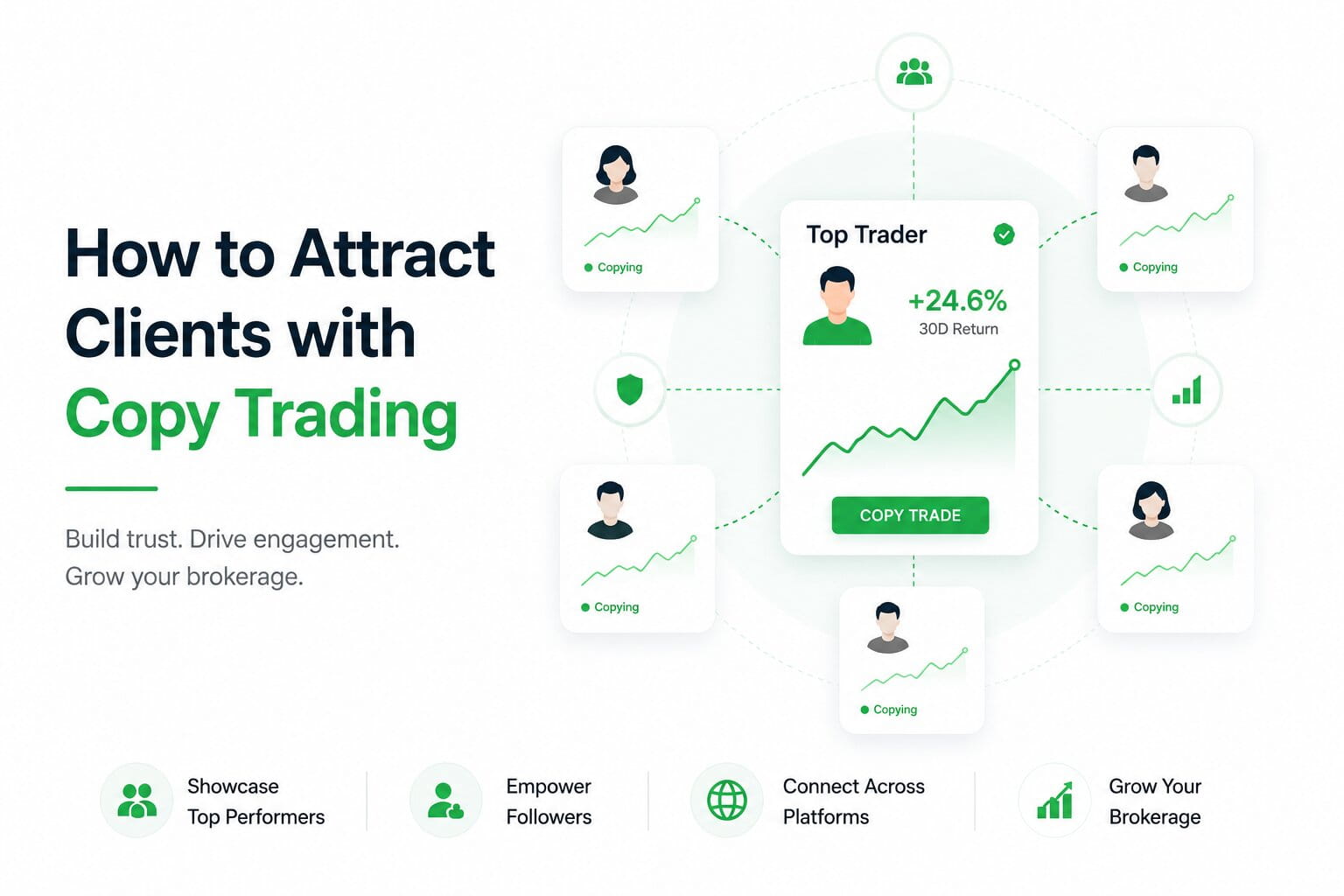
Here’s what usually happens to many new retail traders within the first 90 days. They fund an account, struggle to find their footing, lose money, and leave. That churn is expensive for brokers, costing them real money in acquisition expense with little to no return.
Copy trading solves the first problem every new trader faces, allowing a beginner to replicate a verified signal provider and start participating from day one. Their account stays active, confidence builds, and the broker keeps a client who would have otherwise gone quiet.
Copy trading has shifted from a nice-to-have feature to core brokerage infrastructure. Brokers who have integrated it are seeing measurable improvements across client numbers, trading volume, and revenue retention. Brokers who haven’t are losing clients to those who have.
This article breaks down why copy trading matters in 2026, how to pick the right infrastructure, and how brokers are generating revenue from it today.
Why Copy Trading Is Critical for Brokers in 2026
The global copy trading platform market reached $4.3 billion in 2024 and is growing at a compound annual growth rate of 17–20%, with some projections placing it at over $15 billion by 2033. That trajectory reflects real adoption by brokers who have identified copy trading as one of the most reliable ways to grow funded accounts, keep clients active, and generate consistent revenue.
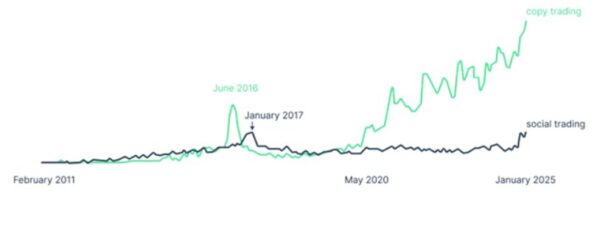
The numbers reflect this shift in broker behavior. Brokeree’s own research found that nearly 38% of brokers already offer some form of social trading, a figure that continues to climb as the product moves from differentiator to standard offering. On the demand side, year-over-year search volumes for copy trading have risen between 22% and 38% annually. As of last reported data, April 2024 marked an all-time high in related search traffic. And for brokers already running active copy trading campaigns, the revenue impact is direct. Brokeree’s data, shared with Finance Magnates, shows that brokers with well-integrated copy trading systems generated between 10% and 20% of their total trading volume from copy trading in 2024, making it a revenue stream large enough to change the shape of a broker’s business.
Here are the key benefits of copy trading for brokers in 2026 across the four areas that matter most.
Increased Trading Volume
When traders copy a signal provider, every trade the provider makes is replicated on the follower’s account. One active signal provider with 50 followers multiplies their trading activity across the entire follower pool, generating spreads, commissions, and platform revenue.
Unlike sporadic discretionary trading, where clients log in, hesitate, and often do nothing, copy trading creates consistent volume. Followers don’t need to make active decisions. Trades execute automatically, within your infrastructure, on your spread.
The forex market is growing in parallel. Daily global forex trading volume reached $9.6 trillion in April 2025, a 28% increase from $7.5 trillion in 2022. Brokers capturing a reliable share of that activity through automated copying are better positioned than those that depend on clients trading independently.
Lower Client Acquisition Barrier
The conversion problem starts before a trader ever places their first real trade. Most new clients register, browse the platform, and hesitate because trading independently requires a level of conviction that most beginners don’t yet have. That hesitation is where funded accounts are lost before they even generate meaningful activity.
With a copy trading system, clients can choose a signal provider whose performance record speaks for itself, allocate capital, and enter the market immediately. This matters beyond just onboarding. When a beginner sees their account generating activity tied to a real trader’s performance, the decision to fund the account becomes easier because the value of the platform is visible on day one.
Some of the most established brokers in the retail space have reported copy trading ecosystems with more than 600,000 active copiers and nearly 100,000 signal providers. That kind of scale takes years to build, which is precisely why brokers who made copy trading a core part of their product offering early are significantly harder to compete with today.
Higher Retention
The biggest reason clients leave brokers is not strategy but frustration and inactivity. A new trader who loses three positions in a row would likely stop logging in. A dormant account is, for practical purposes, lost revenue.
Copy trading addresses this directly. When a follower account is tied to a signal provider’s activity, the account stays active regardless of whether the client is watching. There are no extended gaps in trading. The client’s portfolio keeps moving.
Social trading gives inexperienced traders a way to stay active without needing to trade independently, and it gives your most experienced traders a financial reason to stay on your platform rather than taking their expertise to external fund management firms. Both ends of your client base get a reason to stay; beginners through participation, experienced traders through the revenue and reputation they build as signal providers within your ecosystem.
Stronger Platform Engagement
Beyond raw volume, copy trading makes your platform stickier. Followers log in to check performance. Signal providers log in to manage their strategies. Both groups interact with ratings, metrics, and strategy data, behavior that drives session frequency and correlates directly with additional deposits and referrals.
Two features amplify this: Ratings Module and the Social Trading mobile app. The Ratings Module surfaces verified provider performance through leaderboards and embeddable widgets, giving traders a consistent reason to return and engage. The mobile app extends that habit beyond the desktop where providers and followers can monitor performance, manage strategies, and act on market activity from anywhere. In April 2026, Brokeree also released a redesigned platform interface with role-specific dashboards and performance heatmaps, making the platform faster to navigate for every user type.
How Brokers Make Money with Copy Trading
Copy trading generates revenue through several distinct channels. Understanding them helps you configure your setup to capture each one.
- Spread revenue from follower activity: Every trade copied to a follower account executes on your spread. A signal provider with 100 active followers generates 100x their own trading volume in spread revenue for your broker. This is the core volume multiplier that makes copy trading financially significant.
- Platform fees from signal providers: Brokers can charge signal providers a platform fee for accessing the copy trading ecosystem. This fee is typically calculated as a percentage of the performance fee that providers charge their followers. The more active providers on your platform, the more this revenue stream compounds.
- Performance and management fee structures: Beyond the platform fee, brokers can configure multiple fee modes for signal providers to charge their followers, like performance fees, management fees, and registration fees. Each model serves different provider profiles and client preferences, and brokers set the parameters.
- Long-term retention value: The revenue impact of keeping a client active for 18 months instead of 6 is substantial. Copy trading extends average client tenure by keeping accounts active through periods where a discretionary trader would go dormant. That extended activity: spread revenue, deposits, and referrals, compounds over time.
- Referral effects from strong providers: High-performing signal providers attract followers organically. When a provider builds a reputation on your platform, they bring their own audience with them. That acquisition cost is effectively zero for the broker.
Managing Risk in Social Trading
Copy trading introduces a distinct set of risks that differ from standard discretionary trading and how well a broker’s infrastructure handles them determines whether the system builds trust or erodes it.
According to Finance Magnates, risk management in social trading operates on two levels: protecting the broker’s operational infrastructure, and giving traders the tools to protect themselves.
- At the broker level: The primary risks are execution reliability, hosting stability, and administrative control. Brokeree handles these through a dedicated Copy Module that monitors each server at set intervals and automatically corrects discrepancies in copied trades; server-side hosting that keeps latency low and client data within the broker’s own infrastructure; backup installation for continuity during failures; and a restricted administrators feature that enforces a clear permission hierarchy, to limit the risk of unauthorized changes or human error.
- At the trader level: Risk management centers on three things: meaningful provider data, proportional copying, and position-level controls. The platform surfaces over 100 performance indicators per provider, so followers can make informed decisions before subscribing. Proportional copying allows followers to scale positions relative to their own account size rather than mirroring a provider’s full capital exposure. And at the subscription level, advanced stop-loss and take-profit settings let traders set total loss thresholds per provider, automatically closing positions, pausing copying, or unsubscribing entirely when those limits are reached.
Together, these layers mean risk is managed at every point in the copying chain, not just at the order level, but across the infrastructure, the administration, and the individual follower’s account.
Limitations of Basic Copy Trading Solutions
Not every copy trading implementation delivers the same results. There are real differences between a capable infrastructure and a basic plugin that creates more problems than it solves.
Common limitations with underdeveloped CT solutions:
| Limitation | Business Impact |
| Single-platform only (MT4 or MT5, not both) | Fragment your client base; MT4 and MT5 clients can’t interact |
| Limited risk controls | Creates compliance exposure and client complaints |
| No scalable fee configuration | Broker and signal provider revenue models are rigid and hard to optimize |
| No integration with existing CRM | Operational overhead increases; data stays siloed |
| No follower-level customization | Clients cannot adjust copy ratios, set individual stop-loss levels, or pause copying without exiting entirely |
These gaps are particularly damaging for brokers running clients across multiple platforms or planning to grow. A solution that works for 100 followers often breaks down at 1,000. Basic tools can’t substitute for infrastructure designed to scale.
What to Look for in a Copy Trading Solution
What brokers need in 2026 is a system designed to run across your full trading environment, at scale, with the flexibility to adapt as your client base grows. These are the criteria that separate a production-grade infrastructure from one that creates more problems than it solves.
- 1. Multi-platform support: If you operate across MT4, MT5, and cTrader, your copy trading environment should connect them all. Traders on any of those platforms should be able to follow signal providers on any other, without logging out or managing separate accounts. Cross-server copying within a single unified system eliminates the fragmentation that forces brokers to run parallel setups for different client segments.
- 2. Full broker control and risk management: The ability to define which traders qualify as signal providers, configure group-level rules, set risk limits by account type, and manage hierarchy within your operations team. At the follower level, that means proportional copying, follower-level stop-loss and take-profit settings, and administrator permission hierarchies that prevent unauthorized changes.
- 3. Flexible fee configuration: Your revenue model should be configurable without requiring technical involvement. Whether you run performance fees, management fees, registration fees, or a combination, the infrastructure should support it and let your admin team adjust parameters as your client base evolves.
- 4. Scalable architecture: A system that requires manual intervention every time you add a new server or onboard a new provider group is not scalable. The infrastructure should accommodate growth without creating operational bottlenecks, and handle increased signal providers and followers without degrading execution quality.
- 5. System integration and execution quality: CRM integration, risk management system compatibility, and support for your regulatory reporting processes are all necessary for copy trading to function as part of your business rather than a separate operation. Low-latency trade replication is equally critical, slippage at scale erodes follower confidence and generates complaints.
- 6. Transparent analytics and provider vetting: Followers need verified, real-time performance data, like drawdown, win rate, trade frequency, and risk exposure, to make informed decisions before subscribing. Brokers need the same visibility to monitor provider quality and maintain platform credibility.
- 7. Mobile access: A mobile app that gives both providers and followers access to manage accounts, monitor performance, and act on market activity from anywhere extends platform engagement beyond the desktop and keeps accounts active between sessions.
ALSO READ: What Is Social Trading? How Brokers Use It to Attract, Engage, and Retain Traders
Brokeree Social Trading: Built for Brokers Who Need Infrastructure
Brokeree’s Social Trading platform supports MT4, MT5, and cTrader environments, and the March 2026 Integration API extends it further, allowing any financial institution to embed social trading regardless of which platform they run.
It functions as infrastructure installed on your servers, integrated with your trading environment, and configured to your operational rules. Here are some of the key features of the platform:
- Cross-platform: Signal providers on MT4 can have followers on MT5 or cTrader, and vice versa. All signal sharing occurs across platforms and servers within a single unified system. This removes the fragmentation that forces brokers to run separate copy trading setups for different client segments.
- Broker control at every level: Access control, group-level configurations, restricted administrator roles, and per-account risk rules give you full visibility and control over how the system operates.
- Flexible revenue configuration: The platform supports performance fees, management fees, registration fees, and platform fees. All are configurable and adjustable by your admin team without requiring technical involvement, so you can test and optimize your revenue model as your client base evolves.
- Ratings Module and mobile app: Ratings Module lets brokers showcase signal provider performance through custom widgets embeddable on their website, client portal, or trading room. The mobile app extends access to both providers and followers on iOS and Android, keeping accounts active and engaged beyond the desktop.
READ ALSO: How to Acquire and Retain Traders With Social Trading
The system is hosted on your servers, meaning no client data leaves your infrastructure. With assisted setup, the platform is typically ready to use within 2–3 hours of installation, and Brokeree’s support team is available around the clock for both initial deployment and ongoing maintenance.
Explore the Brokeree Social Trading platform to see how it fits your existing infrastructure.
Conclusion
Copy trading is not a feature you add to make your platform look competitive. In 2026, it is the mechanism through which brokers convert registered accounts into funded ones, give inexperienced traders a viable reason to stay active, and generate consistent trading volume through signal providers whose followers trade automatically behind them.
The market data shows that the copy trading segment is growing faster than most other retail trading categories. Brokers who have invested in proper infrastructure, like Brokeree’s Social Trading, are already capturing that growth. Those who haven’t are operating with a structural disadvantage that becomes harder to close the longer it persists.
So, the question is no longer whether copy trading belongs in your product stack but whether your current setup is built to run it at scale.
FAQs
What is copy trading for brokers?
An automated model where followers replicate a signal provider’s trades in real time. For brokers, it’s the infrastructure that drives client engagement and retention, as well as trading volume, while opening additional fee-based revenue streams.
What are the key benefits of copy trading for brokers?
Lower acquisition barriers, consistent trading volume from automated copying, stronger client retention, and multiple revenue channels, including platform fees, performance fees, and management fees.
What is the difference between copy trading and social trading?
Copy trading is the automated replication of trades. Social trading is the broader infrastructure around it, including performance transparency, strategy ratings, and provider discovery. Most brokers deploy social trading as a system that enables copy trading.
What should brokers look for in a copy trading solution?
Multi-platform support, cross-server copying, flexible fee configuration, low-latency trade execution, risk controls at both the broker and signal provider level, transparent performance analytics for provider vetting, scalability, and clean integration with existing CRM and back-office systems.
Can copy trading work across MT4, MT5, and cTrader simultaneously?
Yes, with the right infrastructure. Solutions like Brokeree Social Trading support cross-platform copying, so a signal provider on one platform can have followers on another, creating a unified trading pool across your full server environment.