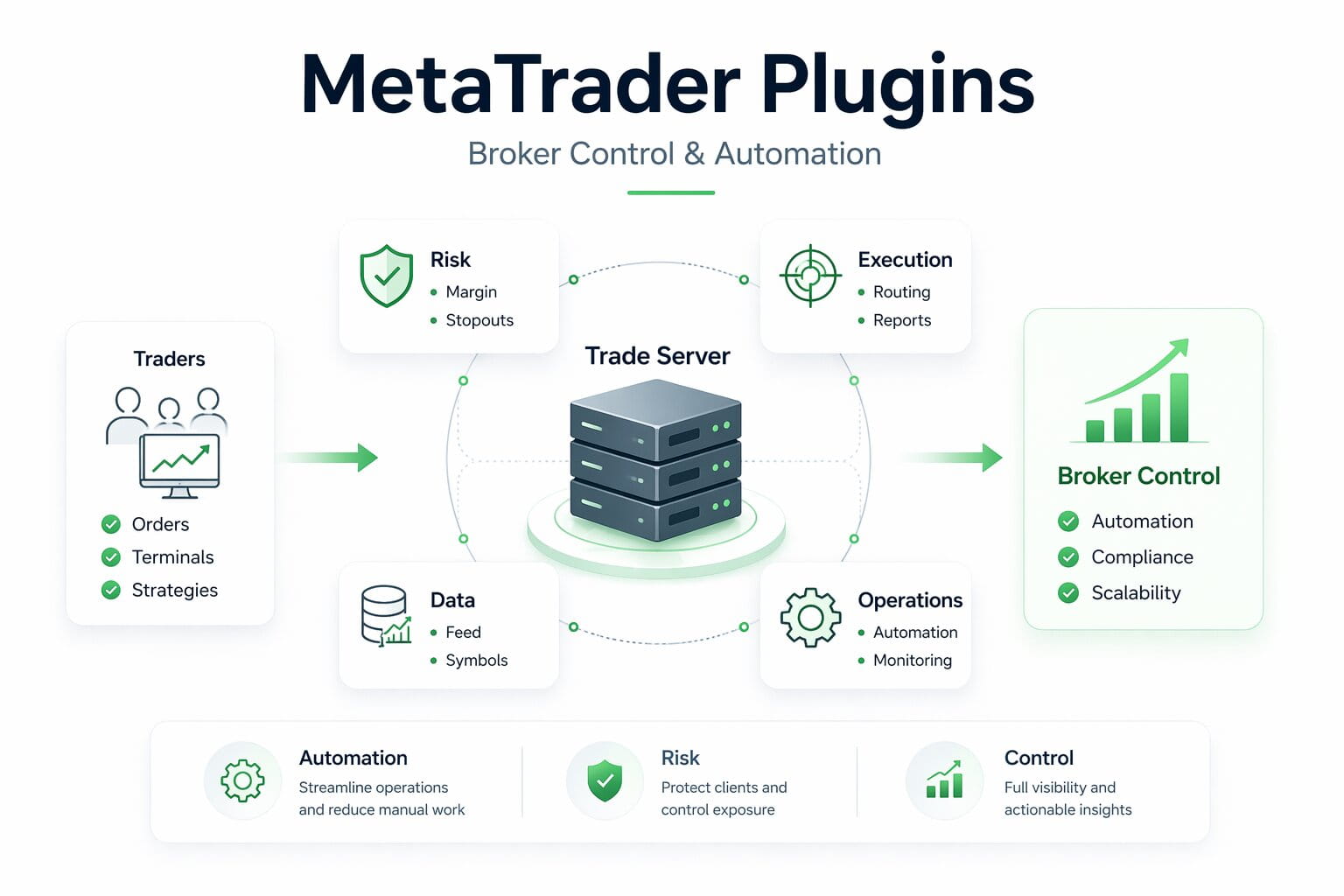
MetaTrader plugins are server-side tools that extend the functionality of MT4 and MT5. They help manage how margin is calculated, credits are managed, risk is monitored, and execution behaves across every account on your server.
Without them, many advanced brokerage operations would need to be handled manually, increasing the risk of errors, operational overhead, and exposure.
MT4 and MT5 plugins cover nearly every layer of your brokerage operations. If you’re still wondering which plugins are worth your attention, this guide is for you. We’ve compiled 15 of the most important MetaTrader plugins for forex brokers: what each one does, which problem it solves, and how to decide which ones belong in your stack.
Key Trends and Technologies Shaping MetaTrader Plugin Demand in 2026
Before getting into the list, it helps to understand why MT4 and MT5 plugin adoption has accelerated for forex brokers. Three key factors are driving this trend.
-
Traders want more than forex:
The standard forex offering no longer cuts it on its own. Cryptocurrency CFDs now account for around 12% of total CFD trading volume, up from 5% in 2020. At the same time, demand for metals, indices, and futures continues to grow.
Brokers expanding their instrument range need plugins like MT5 Synthetic Symbols to create new tradable assets from existing price feeds, without the cost and complexity of sourcing entirely new data connections.
-
Automation and algorithmic trading are now standard:
Algorithmic trading adoption has increased, with 35% of retail traders now using automated strategies or Expert Advisors. That puts real pressure on broker infrastructure.
High-frequency activity at scale creates execution risks that manual oversight can’t catch fast enough. The right plugins automate risk detection, execution control, and margin management, allowing brokers to stay in control without requiring a dealer to monitor every account.
-
Regulation is tightening across major jurisdictions:
The EU’s Benchmarks Regulation, FCA safeguarding rules, and ESMA’s leverage caps have raised the compliance bar for retail brokers. Meeting these requirements on MT4 typically means relying on plugins.
Tools like Dynamic Margin & Leverage, Negative Balance Protection, and Execution Report are how brokers close that gap and document that they’re meeting client protection standards.
ALSO READ: MT4 vs. MT5: Key Differences for Modern Brokers (2026 Edition)
15 MetaTrader Plugins for MT4 and MT5 Brokers
1. MT4/MT5 Dynamic Margin & Leverage
Dynamic Margin & Leverage lets brokers configure leverage and margin requirements based on a per-account and per-symbol basis, and apply those changes across servers from a user-friendly interface. Brokeree recently launched its Plugin Configurator, a centralized web dashboard that currently supports this plugin, with more to follow.
2. MT4/MT5 Margin-Credit Tracker
Margin-Credit Tracker withdraws credit on a margin call or a stopout to prevent clients from going below a zero balance. Brokers can configure the trigger using two methods: an equity-to-credit ratio or a margin level calculated without the credit. Either way, the credit is removed before the account spirals deeper into a loss position.
This works alongside Negative Balance Protection (explained below) as a layered approach to protecting both the client and the broker from runaway drawdowns on credited accounts.
3. MT4 Negative Balance Protection
When a client’s deposited balance drops to zero and they’re still trading on credit, there’s a real risk the account will end up in negative territory, meaning the client owes the broker money. Negative Balance Protection prevents this by automatically topping up the account balance when it drops below zero, stopping losses at the point of depletion.
This is relevant for brokers running bonus or credit programs. It also addresses a growing regulatory expectation: several financial regulators, including those under ESMA, now require brokers to prevent retail client accounts from going negative. Brokeree’s Negative Balance Protection plugin handles this automatically, removing the need for manual intervention or after-the-fact reconciliation.
4. MT4 Symbol Schedule
MT4’s native platform gives brokers limited control over trading session configuration. MT4 Symbol Schedule extends this by allowing brokers to configure trading sessions with 1-second precision per symbol, giving them full control over the process.
The plugin can also block ticks and pending order activations for specified symbols according to a defined schedule, without affecting other instruments on the server.
5. MT5 Synthetic Symbols
MT5 Synthetic Symbols allows brokers to expand their list of tradable instruments by creating new ones from existing price feeds. For example, instead of listing gold as a single 100-troy-ounce contract, a broker can offer it in grams or kilograms. A low-priced crypto like TRX can be displayed as TRX1000 at a more readable price. Multiple assets can also be combined into a custom index with weighted coefficients.
The plugin also includes built-in hedging: when a synthetic instrument is traded, it automatically converts the volume back to the original size and routes it to a coverage account.
6. MT4/MT5 Execution Report
Execution Report generates detailed reports on aggregated spreads received from liquidity providers across a specified period. Brokers can filter by account, symbol, or time range, and export the data to Excel for further analysis. When multiple MetaTrader servers are connected, the plugin provides a consolidated snapshot of spread data across all of them.
As regulatory requirements tighten around trade reporting and execution-quality disclosure, Execution Report provides brokers with the documentation they need. Brokers rely on tools like this to disclose trading costs and meet reporting obligations, particularly on MT4, where native compliance tooling is more limited than on MT5.
7. MT4/MT5 Trade Copier
Trade Copier replicates positions from one master account to one or many follower accounts. Brokers use it to manage proprietary trading accounts, create internal hedging setups, or mirror trades across groups for risk analysis.
Key functions include volume scaling with multipliers, direction reversal for accurate book representation, and group-level filtering, making it one of the most versatile plugin tools available.
8. MT4/MT5 Symbol Editor
Symbol Editor allows brokers to update symbol settings, including swaps, in bulk, automatically, based on data from liquidity providers. Instead of logging into each server and editing instruments one at a time, your team makes one update, and it propagates across the board.
For brokers running dozens or hundreds of symbols across multiple servers, this saves hours of manual work per week and reduces configuration errors that affect client pricing.
9. MT4/MT5 Swap Manager
Swap Manager gives brokers more flexibility over how swap fees are configured and processed. Brokers can set a fixed fee per trade, a fixed fee per lot, or add a markup percentage to the default swap value.
The plugin also lets brokers specify a swap-free period of several days for newly registered accounts or for new trades on specified symbols. Swaps can be aggregated and processed either as a balance transaction with a custom comment or as part of the position itself.
10. MT4/MT5 Feed Server
Feed Server allows brokers to receive raw quotes and symbol information from multiple market data sources, filter spikes, and stream stable price feeds directly to their MT4 or MT5 platform. It covers forex, cryptocurrencies, CFDs, metals, indices, and stocks.
The plugin also lets brokers apply markups on incoming prices and filter out spikes before quotes reach the trading platform. Even the smallest delays or data errors in a price feed can affect risk management and execution, making a reliable feed solution an essential part of brokerage infrastructure.
11. MT4/MT5 System Alerts
System Alerts provides dealers and system administrators with real-time monitoring of trading server performance and notifies them of issues as they occur. This gives brokers the information they need to act quickly when something goes wrong on the server, rather than discovering problems after the fact. Brokers can configure alerts for the following events:
- MetaTrader 4 and 5 server uptime and outages;
- Connection status of feeds and gateways;
- Discrepancies in incoming quotes and ticks;
- New deposits or withdrawals;
- High-risk trading activity;
- Errors and warnings in MetaTrader 4 and 5 server logs.
12. MT4/MT5 Advanced Stopouts
Advanced Stopouts changes how MetaTrader handles margin calls. Instead of closing a client’s position when margin runs low, the plugin can hedge the trade, giving the client time to respond before losses are realized. It’s also configurable at the individual account level, so you can apply it selectively across specific client groups or account types.
13. MT5 Future Rollovers
Future Rollovers automates position transitions when futures contracts expire. The plugin moves client positions from the expiring symbol to the new one and automatically processes the price difference as a balance operation, with a full audit trail.
For brokers offering futures trading, this removes one of the most operationally tedious recurring tasks on the calendar.
14. MT4/MT5 Extended Agent Commissions
MetaTrader’s default commission setup allows brokers to assign one agent per trading account, sufficient for a small IB network, but limiting as the network grows. Extended Agent Commissions improves on this by allowing brokers to build unlimited agent chains, where each agent’s commission is calculated based on the total number of agents in the chain.
Brokers can configure commissions as a percentage of spread, a fixed amount per lot, or a fixed amount per trade. Additional rules include distributing bonuses for trades that stay open longer on specified symbols, and minimizing bonus distribution chains for short-duration trades such as scalping. Chains are managed through a Rule Configurator interface.
15. MT5 Gateways
MT5 Gateways integrate directly with the MT5 trading server to connect it to a specific liquidity provider. Once installed, it maps your symbols to the LP’s list, and trades flow straight from the platform to the provider.
Brokeree offers MT5 Gateways to several major providers, including AC Markets (Europe), LMAX, SAXO Bank, Exante, and DASTrader. It’s best suited for brokers running a single-provider STP model. If you need to aggregate liquidity from multiple providers or run a hybrid execution model, a Liquidity Bridge is the more appropriate route.
At a glance:
| Plugin | Primary Use |
| Dynamic Margin & Leverage | Leverage configuration |
| Margin-Credit Tracker | Credit withdrawal at risk threshold |
| Negative Balance Protection | Prevents sub-zero client balances |
| MT4 Symbol Schedule | Trading session precision control |
| MT5 Synthetic Symbols | Custom instrument creation |
| MT4/MT5 Execution Report | Spread reporting and compliance |
| Trade Copier | Internal copying / hedging / risk monitoring |
| Symbol Editor | Bulk symbol and swap updates |
| Swap Manager | Flexible swap configuration |
| Feed Server | Price data filtering and spike prevention |
| Systems Alert | Real-time server monitoring and notifications |
| Advanced Stopouts | Margin call hedging |
| Future Rollovers | Futures contract transitions |
| MT4/MT5 Extended Agent Commissions | IB commission management |
| MT5 Gateways | Direct LP connectivity for STP brokers |
READ ALSO: Essential MT4 Plugins for Forex Brokers
How to Choose the Right MetaTrader Plugin
With over 50 plugins available for MT4 and MT5, knowing where to start isn’t always obvious. These four questions will help you narrow it down.
- What specific problem are you trying to solve?
Every plugin should have a clear job. If your team manually updates swap rates across multiple symbols every week, Symbol Editor is the solution. If credited accounts are creating risk exposure, Margin-Credit Tracker and Negative Balance Protection should come first. Start with your biggest operational pain point.
- What execution model are you running?
Your model determines your priorities. STP brokers need clean data feeds and reliable execution reporting. Market makers running internal risk need Dealing Desk and Advanced Stopouts. Hybrid brokers likely need both. Your execution model should guide your plugin selection.
- Which platform are you on?
Some plugins work across both MT4 and MT5. Others are platform-specific: MT4 Symbol Schedule is MT4-only, while MT5 Synthetic Symbols, Future Rollovers, and MT5 Gateways are MT5-only. If you’re running both platforms, confirm your vendor supports each before committing.
- Can your team manage the configuration?
Plugins require setup, updates, and ongoing monitoring. If you’re running multiple servers across regions, managing each one individually gets heavy fast. Brokeree’s Plugin Configurator was built for exactly this: a single dashboard for all your MT4 and MT5 servers, so your team doesn’t have to log into each instance separately.
ALSO READ: MT4/MT5 Solutions Packages for Forex Brokers
Conclusion
A well-run brokerage in 2026 doesn’t look like one from 2018. The operational bar is higher, client expectations are more specific, and the brokers pulling ahead are the ones who’ve stopped treating their platform as a finished product.
Dynamic Margin & Leverage, Margin-Credit Tracker, and Negative Balance Protection form a layered safety net for client accounts. Feed Server and Advanced Stopouts keep execution clean and risk visible. Trade Copier, Symbol Editor, and Swap Manager handle the operational details. MT5 Synthetic Symbols, MT5 Gateways, and Future Rollovers give MT5 brokers the instrument range and connectivity to compete across more markets.
Brokeree Solutions offers more than 50 products and plugins across this full range for MT4, MT5, cTrader, and DXtrade. If you want to explore which combination best fits your brokerage, contact our team to find the right setup.
FAQs
-
What is a MetaTrader plugin?
A MetaTrader plugin is a software extension installed on the broker’s server that adds functionality beyond what the standard MT4 or MT5 platform provides natively.
-
What’s the difference between MT4 and MT5 plugins?
MT4 and MT5 have different server architectures, so plugins are built specifically for each. Many providers, including Brokeree, offer the same functionality across both platforms, but the underlying code differs. Some features, like Future Rollovers, are MT5-only because MT4 doesn’t natively support futures instruments.
-
Do I need all these plugins?
No. Start with what solves your current operational or compliance problems. Most brokers begin with Dynamic Margin & Leverage, Negative Balance Protection, and either Trade Copier or Dealing Desk, then expand from there as the business scales.
-
How many plugins does Brokeree offer?
Brokeree Solutions offers more than 50 solutions, plugins, and tools for MT4, MT5, cTrader, and DXtrade, covering client acquisition, risk management, liquidity, money management, and back-office operations. See the full solutions list here.
-
When should I use an MT5 Gateway instead of a Liquidity Bridge?
Liquidity Bridge vs MT5 Gateway: Key Differences
A gateway works best for brokers running a single-provider STP model. It’s simpler to set up and doesn’t require dedicated infrastructure. A Liquidity Bridge is the better fit when you need to aggregate liquidity from multiple providers, run a hybrid A/B-book execution model, or require more advanced routing and risk management controls.