Copy trading has become a core offering for many forex and multi-asset brokers, and for good reason. It lets you expand your investment services, bring less experienced clients into the markets in a way they can manage, give experienced traders a way to put their strategies to work for others, and keep trading activity flowing across your platform. Demand keeps climbing as well, with the global copy trading platform market reaching $4.27 billion in 2024 and on track to hit $15.42 billion by 2033, growing at nearly 17.8% a year.
With the market expanding so quickly, there are now countless solutions competing for your attention, which makes settling on the right copy trading technology genuinely tedious. And the decision reaches well beyond the features your clients see. The platform you pick shapes how cleanly the software works within your existing tech stack, how smoothly clients move through onboarding and trading, how well you can manage risk, the way you earn from the service, and whether the whole thing can scale alongside your brokerage.
This article walks through the key criteria to weigh before choosing copy trading software for brokers.
What is copy trading software for brokers?
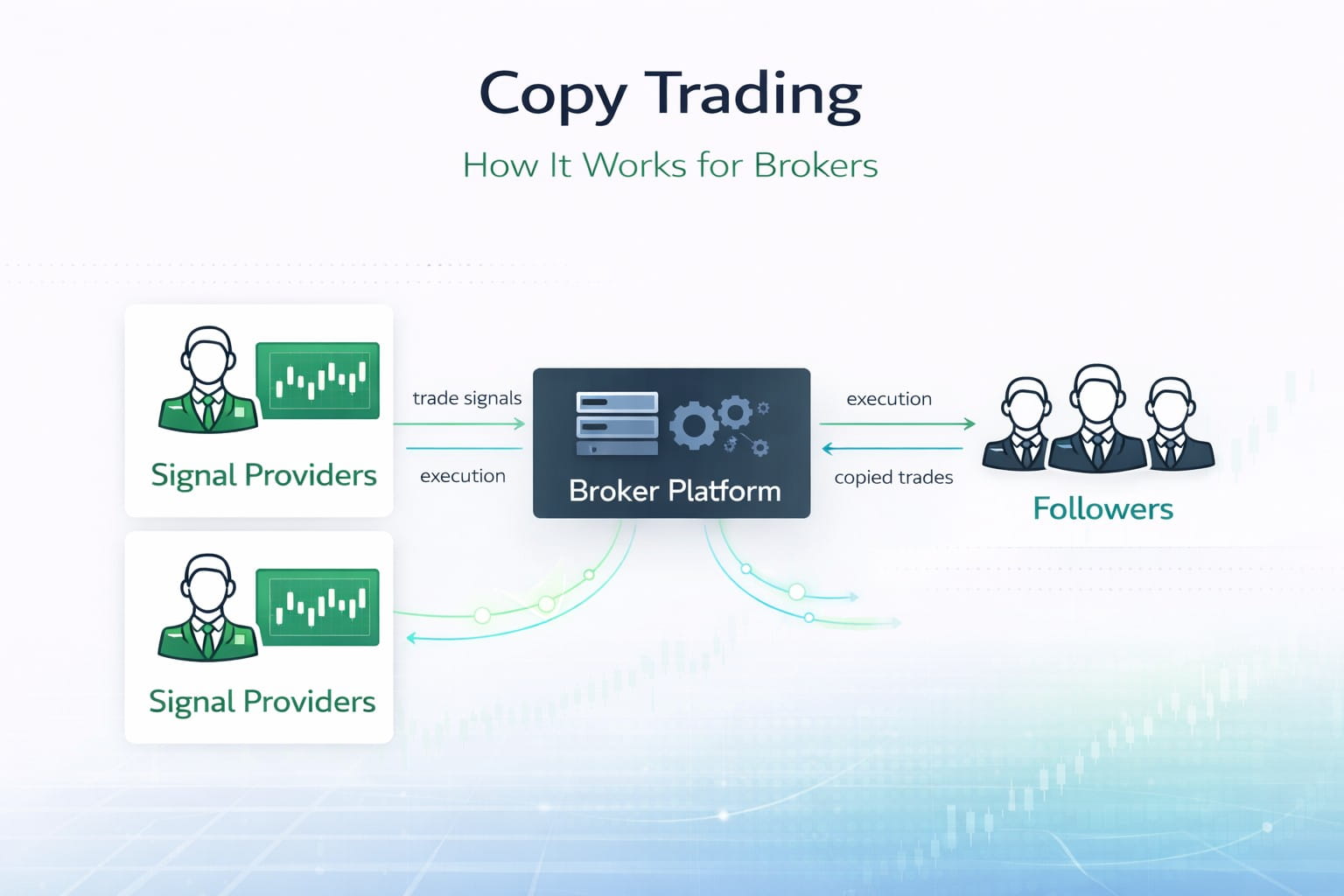
Copy trading software is the technology a broker installs to let clients automatically replicate the trades of other traders. When one trader opens or closes a position, the software mirrors that action across the accounts of everyone following them. Sitting on top of your trading servers, it handles the mechanics of matching trades, applying each follower’s settings, calculating fees, and tracking performance, so an entire investment service runs on autopilot in the background.
In practice, the software organizes three groups around this engine. Signal providers share their strategies, followers subscribe and have those trades copied to their own accounts, and the brokers set the trading conditions, switch features on or off, and monitor everything as it runs.
How to choose a copy trading platform for your brokerage
Start with your brokerage’s business goals
Brokers usually add copy trading for one or more of these reasons: pulling in new clients, lifting engagement among existing traders, improving retention, nudging more trading activity across your platform, giving experienced traders a way to earn from their strategies, widening the overall investment offering, or simply standing apart from competitors selling the same thing.
So, before you compare a single provider, clarify what you want the service to do, because the right copy trading solution follows your goals rather than the other way around.
A broker chasing rapid expansion across several markets will care more about multi-platform reach and how well the copy trading software handles growth. On the other hand, a broker sitting in a community of skilled traders will weigh signal provider onboarding, ratings, and fee settings far more heavily. So name the goal first, and the rest of the comparison becomes much simpler.
Which trading platforms and servers does the software support?
A platform is only useful if it connects to the trading infrastructure you already run. Get the compatibility wrong, and you’re either forcing clients to migrate or running a service that only reaches part of your base, neither of which helps you.
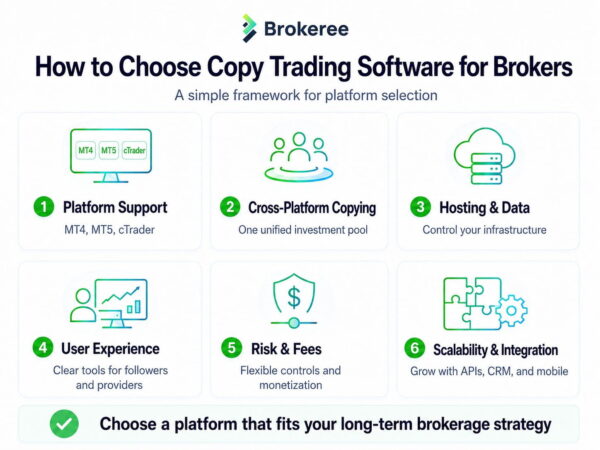
Support for MT4, MT5, and cTrader
Few brokers operate just one environment, and the data backs this up. A 2025 Brokeree analysis of more than 900 brokerages found that 85% run at least one MetaTrader platform, with about 68% offering MT5 and 40% offering MT4, while alternatives like cTrader are steadily gaining ground. Roughly 23% of brokers already run two platforms, and the most common multi-platform setups pair MetaTrader with cTrader. Your copy trading platform for brokers needs to meet you where you are and connect what you’ve already got, rather than asking you to consolidate onto a single platform first. Before anything else, confirm the software supports the exact environments your traders log into today.
Cross-server and cross-platform copying
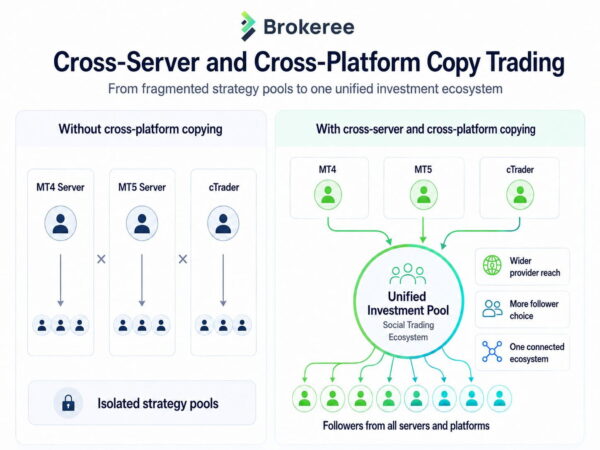
Here’s the part that catches brokers out. If copying only works within a single server, your client base fragments into isolated pools that can’t interact, and that’s wasted liquidity sitting right under your nose. A signal provider on one server stays invisible to followers on another, no matter how strong their results are.
Cross-server and cross-platform copying solves this by consolidating everyone into a single investment pool. A solution that spans environments lets a signal provider on cTrader attract followers across cTrader, MT4, and MT5, while administrators and clients move between platforms without logging out. The result is greater reach for your strongest providers, more choice for your followers, and one pool instead of several fragmented ones.
Integration with additional environments
If you’re running a proprietary platform or some other trading environment, ask one direct question before you sign anything: Is an integration API available? If you run on proprietary platforms, integration APIs for copy trading let you bring copy trading into your infrastructure without long development cycles or launch time.
Evaluate the infrastructure model
Before the interface wins you over, ask where the software lives. Hosting decides who holds your client data, how much control you have over daily operations, and how easily you can meet regulatory and reporting demands later. Here’s how the two main models compare.
Self-hosted solutions
A solution deployed on your own servers gives you far more control over client data. You gain clearer ownership of the investment ecosystem you’re building, more say over your internal workflows, the freedom to develop a strategy pool tailored to your brokerage, and far less dependency on an external shared network you can’t steer.
External network-based platforms
An external network can get you live faster and plug you straight into an existing pool of strategies, which is useful if speed is your priority. However, the trade-off is that you end up relying on a third-party ecosystem, your data may sit on someone else’s servers, and your service starts to look a lot like every other broker connected to the same network. When you’re working off the same shelf as your competitors, standing out gets harder.
Whichever direction you lean, put these four questions to any provider before committing:
Assess the tools for followers and signal providers
A copy trading platform has two sides, which are followers who need a smooth enough experience to stay active, and signal providers who need a good reason to share their strategies, so weigh the tools on offer for each.
On the follower side, look for clear strategy discovery, signal provider ratings, filters and sorting, performance statistics, risk metrics people can actually read, flexible copying settings, the ability to set their own limits, mobile access, and onboarding that doesn’t need a manual. The aim is that clients should be able to compare strategies and make informed decisions without wrestling with a cluttered interface.
Signal providers want a straightforward onboarding process, easy access to their own performance statistics, clear ranking rules rather than guesswork, a way to reach follower segments that suit their style, configurable fee models that reward them fairly, and genuine visibility within your investment ecosystem.
Compare risk-management tools and broker-level controls
Risk management is where you decide how much exposure your brokerage takes on as copying scales. Here’s what to check on both sides.
Risk settings for followers
Your followers need ways to keep their own exposure in check, and good software gives them several: copying limits, equity-related controls, configurable stop-loss settings, volume multipliers, allocation settings, and the freedom to stop copying a strategy whenever they choose.
Broker-level monitoring and configuration
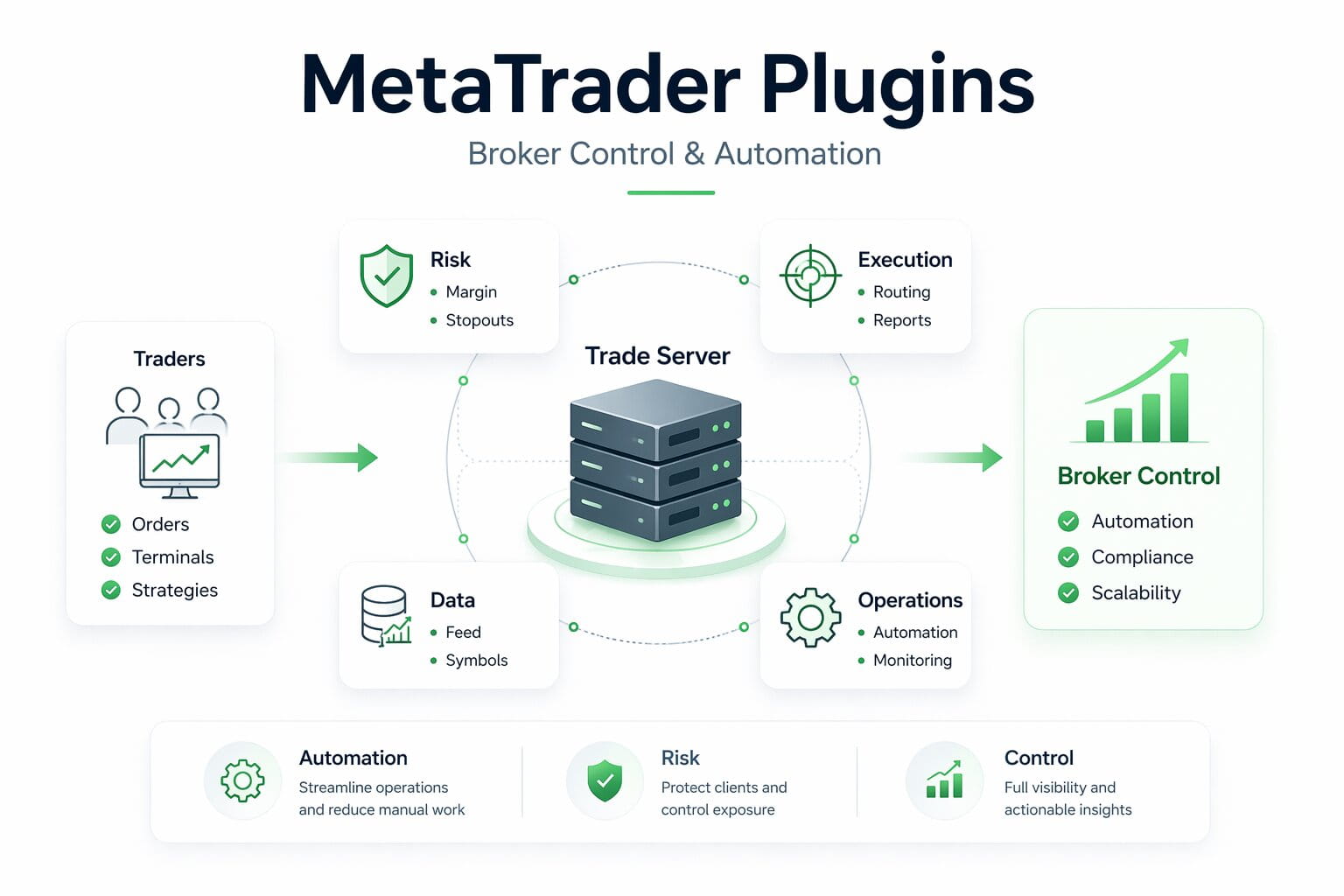
Your team needs the ability to monitor the service and shape the conditions under which it runs. Before you commit to any platform, get clear answers to these:
Understand the monetization options
Copy trading should pay its way. The platform needs to support fee models that match how you run your business. Options you may want available:
No single fee mode is required across the board. The right structure depends on your business model, your audience, and your relationship with signal providers. What you should insist on is flexibility.
Consider branding, user experience, and integration options
Copy trading works best when it feels like a built-in part of your platform rather than a bolted-on extra wearing someone else’s badge. A few questions sort the strong options from the weak ones: Can the interface carry your brand’s colors and logo? Can it sit inside your existing client area? Is there a mobile app? Can you connect your CRM or back-office workflows where needed? Does the client journey stay consistent across different trading environments? Is an API available for other integration scenarios?
Copy trading solutions like Brokeree’s Social Trading tick these off in practice. Its Web UI adapts to your company’s colors and logo, the mobile app gives administrators, providers, and followers their own access on the go, and the solution integrates with CRM systems, including social trading, which integrates with CRMs such as Axis FX, Nullpoint, Techysquad, XCritical, and Syntellicore.
Check scalability and technical support
The platform that fits you today has to fit the brokerage you’re building toward, so pick software that remains manageable as you add more clients, servers, trading platforms, signal providers, new regions, and internal workflows.
Support is the other half of this. You’ll want to know upfront how updates, troubleshooting, integrations, and future expansion get handled, both during implementation and after launch.
Copy trading platform selection checklist
Once you’ve worked through the criteria above, run any shortlisted platform past these questions before you commit:
| Criterion | Question to ask |
| Platform support | Which trading platforms and servers can be connected? |
| Cross-platform | Does it support cross-server and cross-platform copying? |
| Hosting | Where is the software hosted? |
| Data ownership | Who controls the client data? |
| Strategy pool | Is the signal provider pool exclusive or shared? |
| Risk tools | Which risk-management tools are available? |
| Transparency | Can followers compare strategies with clear performance and risk metrics? |
| Monetization | Which fee models can be configured? |
| Branding | Can I customize the user journey and branding? |
| Mobile | Is a mobile application available? |
| Integration | Can it connect to my existing infrastructure and CRM? |
| API | Is an API available for additional environments? |
| Scalability | Can the platform scale as the brokerage grows? |
| Support | What technical support is available during and after implementation? |
Choosing the right copy trading platform
The best copy trading software for a broker is the one that fits the brokerage you’re running and the one you’re building toward.
That means software that slots into your infrastructure, keeps your data and operations in your hands, supports the trading environments you use, gives clients honest risk-management tools, and bends as your business grows. Get those right, and the feature list takes care of itself.
Brokeree’s Social Trading is built to those specifications. It connects MT4, MT5, and cTrader within a single investment ecosystem, so cross-server signal sharing is built in from the start. Because the solution is self-hosted, client data stays on your servers, and your strategy pool is exclusive to your brokerage rather than a shared network that your competitors draw from.
Social Trading also offers great flexibility in copying modes (Proportional, equity-based, free margin, and multiplier), and the Ratings Module provides followers with performance transparency to make informed decisions. A mobile app, CRM integrations, and an Integration API for proprietary platforms keep the service connected to your existing stack rather than sitting beside it.
FAQs
What is copy trading software for brokers?
Copy trading is a technology that enables a broker to offer a service in which followers automatically replicate the trades of signal providers. The broker sets trading conditions, manages which features are active, controls fees, and monitors the service, all while working with trading platforms like MT4, MT5, and cTrader.
How is broker-level copy trading software different from a retail app?
A retail app serves the individual trader. Broker-level software serves the brokerage. It connects to your existing infrastructure, supports multiple users and servers, gives your team operational controls, and lets you run the service under your own brand.
Why does cross-server copying matter?
Cross-server copying unites traders on different servers, such as MT4 and MT5, into a single investment pool, so a strong provider on one server isn’t hidden from followers on another.
Should I host copy trading software on my own servers?
Self-hosting gives you control over client data, ownership of your strategy pool, and independence from outside networks. A self-hosted solution like Brokeree’s Social Trading keeps client information on your servers rather than with the provider. An external network can launch faster, but ties you to a shared ecosystem.
Is copy trading risk-free?
No, copy trading carries the same market risk as any trading activity. A trustworthy platform makes performance and risk data clear and provides tools such as stop-loss settings and copying limits to help followers manage their own exposure.
How long does it take to launch a copy trading service?
It varies by provider. Brokeree’s Social Trading is typically ready with default settings within about 3 hours of installation, though a full configuration tailored to your business model may require additional setup time.