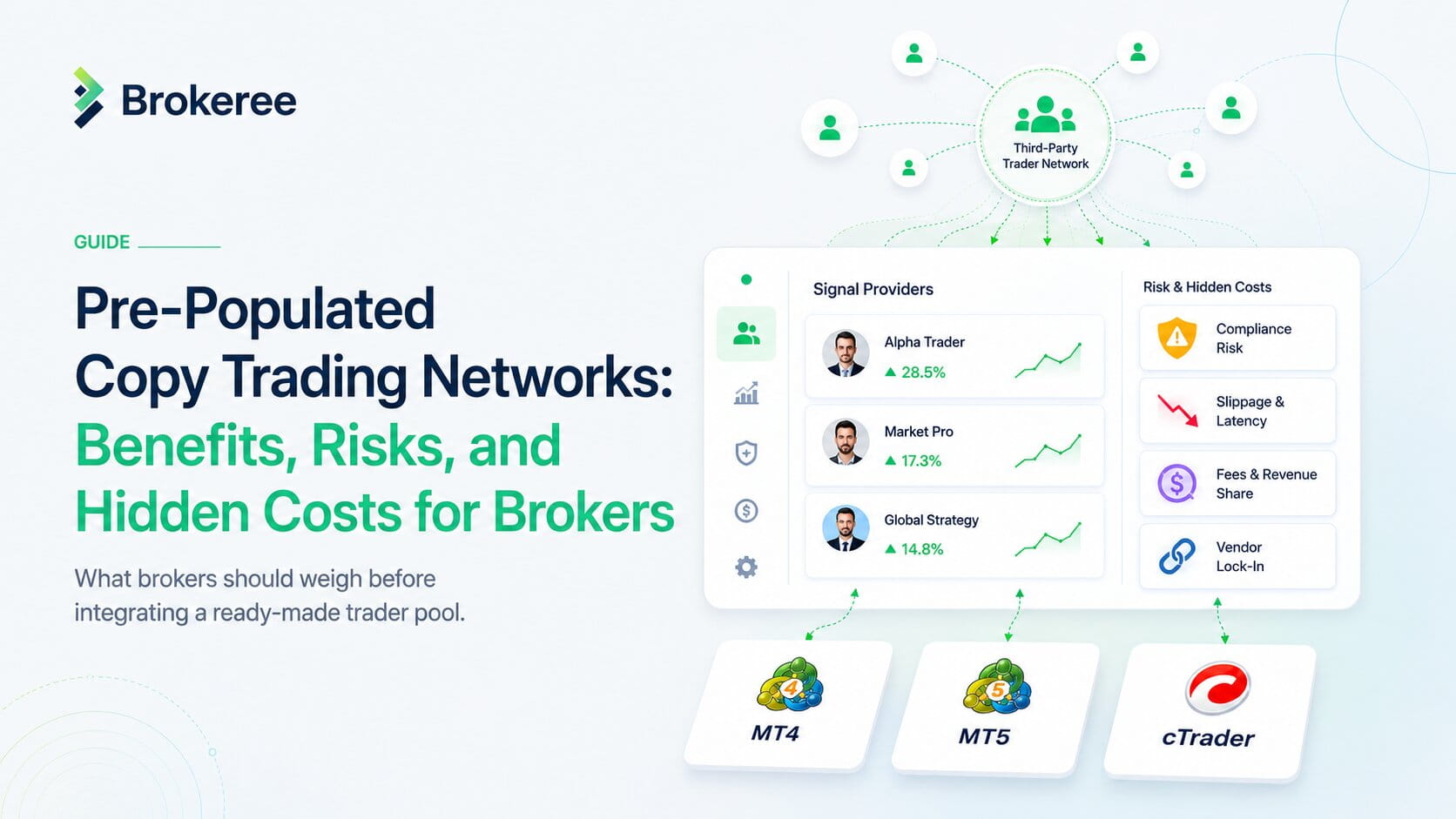
Copy trading remains one of the most effective tools brokers can offer to retain clients and attract new ones. Rather than waiting for traders to develop their own strategies, it lets followers benefit from experienced signal providers automatically, giving passive investors a reason to stay on a platform. The copy trading platform market reached $4.3 billion in 2024 and is on track to reach roughly $15 billion by 2033, growing at nearly 18% a year.
But with this growth, a type of shortcut has emerged that lets brokers plug into pre-populated third-party networks, which are ready-made pools of signal providers, instead of building a proprietary network from their own client base. This helps brokers skip the slow, costly work of recruiting traders and enter the market with a fully populated copy-trading product immediately.
This article walks through what pre-populated copy trading networks offer brokers and where the real risks sit. By the end, you’ll have a clear basis for deciding whether to rent a trader pool or build your own.
Why Pre-Populated Networks are Attractive
The appeal of pre-populated copy trading networks comes down to time and infrastructure. Building your own copy trading system means recruiting signal providers, setting up performance checks, running a follower-facing interface, and handling the technical work beneath it, like allocation, execution sequencing, slippage handling, and performance fee calculation. For most brokers, that is a heavy commitment of engineering and operational time.
Third-party networks remove that burden. They aggregate strategies across dozens of brokers worldwide and give you access to thousands of traders the moment you integrate. ZuluTrade, for example, connects brokers and has run a pool of thousands of signal providers since its early days. For a broker launching a copy trading product or trying to stand out in a saturated market, going live with a full leaderboard on day one is a compelling proposition.
There can be a regulatory upside, too. Some established networks hold their own licenses across multiple jurisdictions, which may ease compliance load for brokers in regulated markets.
Risks of Pre-Populated Copy Trading
The benefits are easy to sell, which is exactly why they get all the attention. However, the structural risks sit quietly, and they tend to surface only after a broker has already built its retention product on someone else’s foundation. These are the ones worth weighing before you sign.
Regulatory exposure you can’t delegate
With a pre-populated network, you often don’t choose the signal providers or control how their track records are presented. If a vendor’s leaderboard shows performance you can’t verify, the compliance question typically falls on the broker, not the vendor, meaning you’re answering for traders you never vetted.
Execution quality and cross-broker slippage
In a shared network, the signal provider and the follower are often trading through different brokers. That extra layer introduces latency, which can lead to slippage and performance gaps between the leader’s results and what followers achieve, especially in fast-moving markets. Clients usually don’t see the network behind the trade. They see your brand. When results don’t match expectations, the broker often absorbs the complaints.
Some shared networks also struggle to copy cleanly across different account types, such as cent to standard accounts, and to replicate stop-loss and limit orders accurately across broker environments. Those are small-print problems that can become support tickets later.
Limited ownership of your provider ecosystem
In a shared copy-trading network, your most popular signal providers are often available to other brokers connected to the same ecosystem. While that broad marketplace can help accelerate launch, it also means the traders who attract and retain your clients may not be exclusive to your brand.
Increased vendor dependency
Shared networks tend to come with constraints. You may be tied to one vendor’s platform, set of copying modes, or server arrangement. If your providers live in an external pool, the data, the relationships, and the leaderboard may never fully belong to you.
The day you want to move, the crowd follows the vendor, and your clients lose the providers and the copy history they built relationships around. A network that changes its fees, alters its terms, gets acquired, or faces regulatory issues can put you in a tight spot with little room to negotiate.
The Hidden Cost Stack of Pre-Populated Copy Trading
The price a vendor quotes is the integration fee or monthly license. The real cost of a pre-populated network sits underneath it, and it shows up on the P&L long after the contract is signed.
| Hidden cost | What it means |
| Revenue share | The network takes a cut of the performance fees your signal providers generate. In a network you own, that money stays with you. |
| Churn from slippage | Followers who underperform the headline strategy because of cross-broker latency disengage and leave. Replacing them costs real acquisition spend that most brokers never trace back to the network. |
| Compliance overhead | Vetting, disclosures, and reporting for traders you didn’t choose. The bill grows with every regulated market you serve. |
| Cost of exit | Leaving means severing the copy relationships your clients built. Locked-in platforms and vendor pricing make the switch slow and expensive. |
| Lost data | Client behavior, which strategies they follow, when they stop, what risk they set, all accrue to the network, not to you. Over time, the vendor knows your clients better. |
Pre-Populated Copy Trading Alternative: Build Your Own Trader Community
There is a second route. Instead of renting a crowd, you grow one and keep it.
The empty leaderboard is a supply problem. The solution is to seed the platform with a small group of credible signal providers rather than waiting for a community to form organically.
To build your leaderboard,
- Convert your top 5% of profitable clients into signal providers. You already have their performance data. Invite and incentivize them, and once they’ve accepted the invitation, onboard and put them on the leaderboard.
- Recruit external signal providers from competing platforms by offering better fee economics, stronger branding opportunities, or better execution quality.
- Run targeted provider acquisition campaigns through your marketing team, affiliate network, trading communities, webinars, and social channels to attract experienced traders looking to monetize their track record.
Most brokers can launch with five to 15 active signal providers. The goal is not a large leaderboard on day one, but a credible one. The community you build answers to your rules, your compliance standards, and your servers. When a provider’s track record appears on your leaderboard, you can verify it, which keeps the regulator’s questions answerable.
Conclusion
Brokeree’s social trading runs your own copy trading service across MT4, MT5, and cTrader from one solution. You approve who qualifies as a signal provider, choose the copying modes (proportional, by equity, free margin, or multiplier), and set the performance fees. A restricted-administrator feature distributes staff permissions, and a ratings module shows clients transparent performance data. Because providers and followers operate within your environment, execution is direct, and cross-broker slippage largely disappears.
Once your providers are live, cross-server social trading extends their reach. Seed providers on an MT4 server, launch MT5 later, and your MT5 clients copy those existing providers right away. The leaderboard you already built carries over, so you don’t have to start from scratch.
FAQs
What is a pre-populated copy trading network?
A copy trading setup that arrives with the signal-provider side already filled, usually from a third-party vendor’s pool. You skip recruiting traders and launch with a full leaderboard immediately. The catch is that those providers belong to the network, not to you.
Is it better to build my own copy trading network or use a third-party one?
Depends on scale. A small or new broker may accept a third-party network’s trade-offs for speed. A broker with a real client base and a strict regulator usually wins by owning it, keeping providers, data, and revenue on its books. Brokeree’s social trading makes the build route reachable across MT4, MT5, and cTrader.
How does a broker recruit signal providers for a new copy trading service?
Start inside your own book. Your most profitable existing clients are the fastest-first providers, since you already have their performance data. A few external providers and graduated prop traders fill out the rest. Most programs reach a working base of 5 to 15 active providers.