If you have been researching how to launch copy trading services at your brokerage, the good news is that the process no longer requires a large development team or a year of custom coding. Most of the work today comes down to picking the right technology, setting the right rules, and giving your best traders a reason to share their strategies.
Interest is also climbing, as the global search activity around copy trading has reached record levels since mid-2025, and Precedence Research expects social and copy trading features to be among the fastest-growing segments of the online trading platform market through 2035.
This guide walks you through the six practical steps to launching copy trading at your brokerage.
How to Launch Copy Trading Services
Before launch, review how copy trading is classified in the jurisdictions where you operate, since disclosure requirements and licensing obligations differ between regulators.
01Choose Your Technology Stack Provider
Your copy trading service is only as good as the engine that powers it. Start by looking for a white-label provider who other brokers trust, that supports the platforms your clients trade on, and that gives you control over risk and revenue settings.
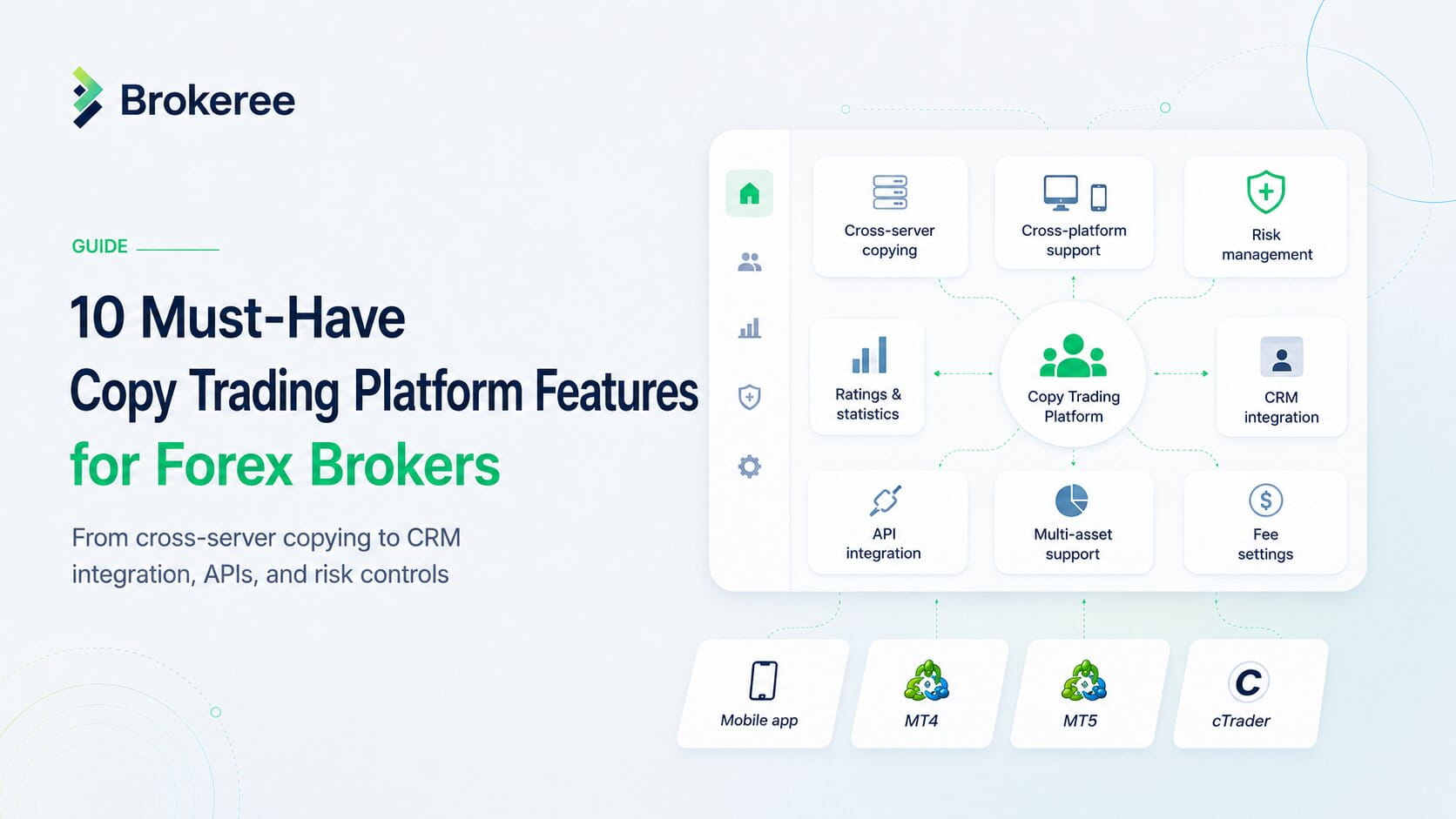
Brokeree’s Social Trading is one such example. The solution supports cross-platform copying across MetaTrader 4 and MetaTrader 5 servers as well as cTrader. It includes risk management features such as flexible copying modes and proportional copying, along with revenue tools that let providers and brokers fine-tune fees. According to Brokeree’s own market research, 40% of the reviewed social trading implementations run on Brokeree technology.
Also, pay attention to how the system separates its users. Solutions with dedicated web portals for administrators, signal providers, and followers make daily operations far easier, because each group only sees the controls relevant to them.
When you speak with any provider, ask where the solution is hosted and who holds client data, how long installation takes, and whether the system can copy trades between different servers and platforms. Clear answers here will save you painful surprises later.
02Look for Relevant APIs (Optional)
This step applies if your business does not run on traditional trading platforms. Financial institutions with proprietary platforms can still offer copy trading through integration APIs that connect their infrastructure to proven white-label technology.
Brokeree, for example, launched a social trading integration API that lets institutions embed copy trading into platforms beyond MetaTrader and cTrader. The appeal of the API route lies in its speed. It reduces custom development by connecting proprietary platforms to an existing copy trading engine. If you operate on a standard MetaTrader or cTrader setup, you can skip this step entirely.
03Liquidity and Execution
You already have liquidity arrangements in place, so this step rarely requires immediate action. It becomes relevant once copy trading gains traction. When one signal provider’s order triggers dozens or hundreds of copied trades at once, your liquidity pool absorbs a sudden volume spike. Thin liquidity at that moment increases the likelihood of slippage, and slippage means followers receive worse prices than the provider they copy.
Keep an eye on execution quality as follower numbers climb. If fills start to degrade during busy sessions, that is your cue to add liquidity providers or deepen your existing pool before clients notice.
04Set Up Risk Management Rules
Set your risk rules before launch, so one bad trade does not drain dozens of client accounts at once. Some risk management settings that are worth looking at are:
- Copying modes: Decide how follower trade sizes are calculated, whether by fixed lot, balance proportion, or equity ratio.
- Proportional copying: Enable it so a follower with $1,000 doesn’t take on the same exposure as a provider trading $100,000.
- Volume and correction limits: Cap the maximum size of copied trades and define what happens to open positions when a limit is breached.
- Provider screening: Restrict accounts that rely on high-risk strategies or aggressive trading from becoming public signal providers.
A good copy trading platform lets you configure these rules per account group, so you can set conservative conditions for newcomers and looser ones for experienced clients.
05Build a Pool of Verified Signal Providers
No signal providers means no copy trading service. Your first and best source is already inside your brokerage. Pull up your most consistent traders over the past 12 months and invite them personally to become providers.
Give them a reason to say yes. Most copy trading systems let providers earn performance fees, management fees, or per-trade fees from their followers, so a profitable trader gains a second income stream without changing how they trade.
Then widen the funnel. Affiliate networks and introducing brokers often work with skilled traders who bring their own audiences. Partnering with IBs to recruit providers gives you new strategies for followers and fresh deposits at the same time, since successful providers often attract their own followers.
Quality beats quantity here. Ten providers with verified track records and controlled drawdowns will retain followers far better than fifty unvetted accounts.
06Create a Public-Facing Dashboard
A public dashboard or leaderboard that ranks providers by returns, drawdown, and trading history turns your copy trading service into a discovery experience rather than a hidden feature.
Clear performance data helps prospective followers evaluate providers before subscribing. When potential followers can compare real performance data, filter providers by risk level, and review trading history before subscribing, they can make more informed decisions. Tools like Brokeree’s Ratings Module display provider performance through interactive widgets that embed directly on your website.
Mobile access belongs in the same conversation. Mobile apps already account for over half of the US online trading platform market by interface, and a growing share of retail clients discover, subscribe to, and monitor strategies entirely on their phones. A copy trading mobile app helps followers monitor and manage subscriptions while away from their desktop platform.
Final Thoughts
The brokers who get the most out of copy trading are the ones that treat it as part of their core infrastructure. When copying runs on the same servers your clients already trade on, follows the same risk framework, and feeds the same back office, the service can contribute to stronger client retention rather than fragmenting your operation.
Brokeree’s Social Trading was built around that idea. Brokers on MT4, MT5, and cTrader can deploy it natively, while firms on proprietary platforms can connect through the Integration API. Either way, you get configurable copying modes, proportional risk controls, and flexible fee structures for providers and the brokerage in one system, with installation measured in hours rather than months.
That is how to launch copy trading services in six steps. If it is on your 2026 roadmap, request a free demo and see how it fits your setup.
FAQs
How long does it take to launch copy trading services?
With a white-label solution, the technical side moves quickly. Brokeree’s Social Trading, for instance, is ready to use with default settings after installation, which typically takes a few hours. Recruiting signal providers and preparing marketing usually takes longer than the technology itself, so plan a few weeks for a polished launch.
Do I need a special license to offer copy trading?
Requirements differ by jurisdiction. Some regulators treat copy trading as a self-directed service, while others require additional money management permissions. Confirm the rules with your legal counsel or compliance officer for every region where you operate before going live.
How do brokerages make money from copy trading?
Successful copy trading often increases trading volumes, which in turn increases spread and commission revenue. Brokers can also charge a platform fee for the service and share in the performance or management fees that signal providers collect from their followers.
Can followers copy trades across different platforms and servers?
Yes, if your technology supports it. Cross-platform solutions, such as Brokeree’s Social Trading, connect multiple MT4, MT5, and cTrader servers into a single investment environment, so a follower on one server can copy a provider registered on another.
What is the difference between copy trading and PAMM?
In copy trading, signals are copied directly into each investor’s own account, and the investor keeps full control over their funds. In a PAMM system, investors allocate funds to a money manager who trades a shared account, with profits and losses distributed automatically according to each investor’s share.